


Losing a loved one is one of the most emotional and challenging moments in life. During this difficult time, families often struggle to understand what needs to be done next. Along with grief, there are several practical responsibilities that require immediate attention.
Arranging last rites involves more than just planning a funeral. Families need to obtain documents, arrange transportation, coordinate religious rituals, book cremation or burial services, and inform relatives. Therefore, having a clear understanding of the process can reduce stress and help ensure a dignified farewell.
Whether the death occurs at home, in a hospital, or elsewhere, following a step-by-step approach helps families manage the arrangements smoothly.
This guide explains how to arrange last rites for a loved one, including documentation, transportation, funeral rituals, cremation arrangements, and professional support services.
What Are Last Rites?
Last rites refer to the religious, cultural, and funeral ceremonies performed after a person’s death.
These ceremonies help family members:
- Pay final respects
- Honor the deceased
- Follow religious traditions
- Complete funeral rituals
- Support emotional closure
The exact rituals vary according to religion, culture, and family traditions.
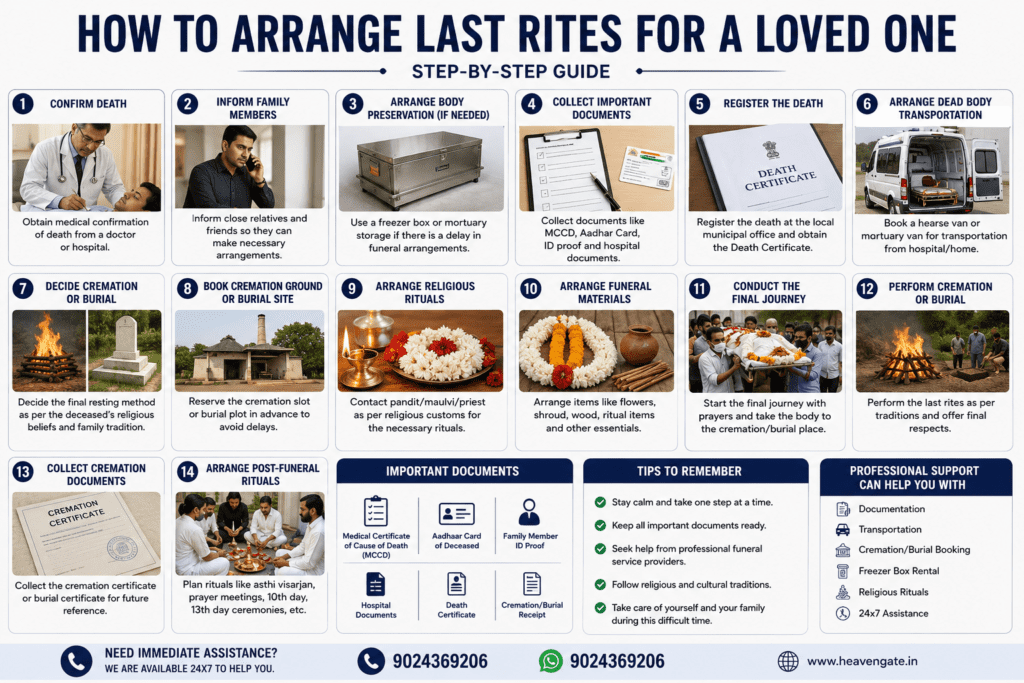
Step 1: Obtain Medical Confirmation of Death
The first step is obtaining official confirmation of death.
If Death Occurs at Home
Contact:
- Family Doctor
- Local Physician
- Emergency Medical Service
A doctor will examine the deceased and issue the necessary medical documentation.
If Death Occurs in a Hospital
The hospital will:
- Confirm death
- Issue a Medical Certificate of Cause of Death (MCCD)
- Complete administrative formalities
Internal Link Opportunity
Read:
What Happens After Death in a Hospital? Complete Guide
Step 2: Inform Close Family Members
After confirmation, notify:
- Immediate family
- Relatives
- Close friends
- Religious leaders
Early communication allows family members to make travel arrangements.
Step 3: Arrange Body Preservation (If Needed)
Sometimes relatives need additional time to arrive.
In such situations, preservation becomes important.
Options Available
Freezer Box Rental
A freezer box helps preserve the body for several days.
Mortuary Storage
Hospitals may provide temporary mortuary facilities.
Internal Link Opportunity
Read:
Freezer Box Near Me in Jaipur
Step 4: Collect Important Documents
Several documents are required for funeral arrangements.
Essential Documents
- Medical Certificate of Cause of Death
- Aadhaar Card of Deceased
- Family Member ID Proof
- Hospital Documents (if applicable)
Keep multiple copies for future use.
Step 5: Register the Death
Death registration is legally required.
Families must apply through:
- Municipal Corporation
- Nagar Nigam
- Registrar of Births and Deaths
- State Registration Portal
The registration process results in an official Death Certificate.
Internal Link Opportunity
Read:
How to Get a Death Certificate in Rajasthan
Step 6: Arrange Dead Body Transportation
Transportation may be required from:
- Hospital to Home
- Home to Cremation Ground
- One City to Another
- Airport to Residence
Transportation Options
Hearse Van
Most suitable for local transportation.
Mortuary Van
Suitable for longer distances.
Air Transportation
Used for interstate and international transfers.
Internal Link Opportunity
Read:
Dead Body Transportation Charges Per KM in India
Step 7: Decide Between Cremation or Burial
The next step is choosing the final resting method according to religious beliefs.
Cremation
Common in Hindu, Sikh, and some Buddhist traditions.
Burial
Common in Muslim, Christian, and Jewish traditions.
Families should coordinate with local religious authorities if required.
Step 8: Book Cremation Ground or Burial Site
Advance booking helps avoid delays.
Common Arrangements Include
- Cremation Ground Reservation
- Electric Cremation Slot
- Wood Cremation Setup
- Burial Plot Reservation
Internal Link Opportunities
- Electric Cremation in Jaipur: Complete Guide
- Best Cremation Grounds in Jaipur
Step 9: Arrange Religious Rituals
Different religions have specific funeral customs.
Common Arrangements
- Pandit Ji
- Priest
- Maulvi
- Religious Ceremonies
- Prayer Gatherings
Families should follow their cultural and religious traditions.
Step 10: Arrange Funeral Materials
Several items may be required.
Common Funeral Materials
- Flowers
- Garlands
- Shroud Cloth
- Ritual Items
- Earthen Pots
- Wood (for traditional cremation)
Many funeral service providers offer complete packages.
Step 11: Conduct the Final Journey
The final journey is an important part of the funeral process.
Families typically arrange:
- Hearse Van
- Funeral Procession
- Religious Prayers
- Final Viewing
Professional transportation ensures dignity and smooth coordination.
Step 12: Perform Cremation or Burial
At the cremation ground or burial site:
Typical Process
- Religious Rituals
- Final Prayers
- Last Respects
- Cremation or Burial Ceremony
The exact sequence depends on family traditions.
Step 13: Collect Cremation Documents
After cremation, families may receive:
- Cremation Receipt
- Cremation Certificate
- Ash Collection Information
These documents may be required later for official purposes.
Step 14: Arrange Post-Funeral Rituals
Many traditions include ceremonies after the funeral.
Common Ceremonies
- Prayer Meetings
- Asthi Visarjan
- 3rd Day Rituals
- 10th Day Rituals
- 13th Day Ceremony
- Memorial Gatherings
These rituals help family members honor the deceased.
Common Challenges Families Face
Lack of Information
Many people arrange last rites for the first time.
Documentation Delays
Missing documents can delay funeral arrangements.
Transportation Issues
Finding reliable transportation quickly can be difficult.
Emotional Stress
Grief often makes decision-making challenging.
Professional assistance can reduce these burdens.
Why Professional Funeral Services Help
Funeral service providers assist with:
- Documentation
- Transportation
- Freezer Box Rental
- Cremation Arrangements
- Religious Ritual Coordination
- Funeral Packages
As a result, families can focus on their loved ones instead of logistics.
Why Choose Heaven Gate Funeral Care?
Heaven Gate Funeral Care provides complete last rites assistance.
Our Services
- Funeral Arrangements
- Dead Body Transportation
- Hearse Van Service
- Freezer Box Rental
- Cremation Services
- Religious Ritual Support
- Documentation Assistance
Why Families Trust Us
- Available 24×7
- Experienced Team
- Compassionate Support
- Transparent Pricing
- End-to-End Assistance
We help families arrange a respectful and dignified farewell.
Frequently Asked Questions (FAQs)
What should I do immediately after a loved one passes away?
Obtain medical confirmation of death and inform close family members.
Is a death certificate required for funeral arrangements?
Yes. It is one of the most important legal documents.
When should I arrange a freezer box?
If funeral arrangements are delayed or relatives are travelling.
How do I transport a deceased person?
You can arrange a hearse van, mortuary van, or air transportation depending on the distance.
Can funeral services help with documentation?
Yes. Professional providers assist with required paperwork.
How long does funeral planning take?
Many arrangements can be completed within a few hours with professional support.
Are funeral services available 24×7?
Yes. Most professional providers offer round-the-clock assistance.
Contact Heaven Gate Funeral Care
Need assistance arranging last rites for a loved one?
📞 Call: 9024369206
📱 WhatsApp: 9024369206
🌐 Website: www.heavengate.in
Available 24×7 For:
- Funeral Arrangements
- Dead Body Transportation
- Hearse Van Service
- Freezer Box Rental
- Cremation Services
- Documentation Support
Compassion • Dignity • Complete Support