

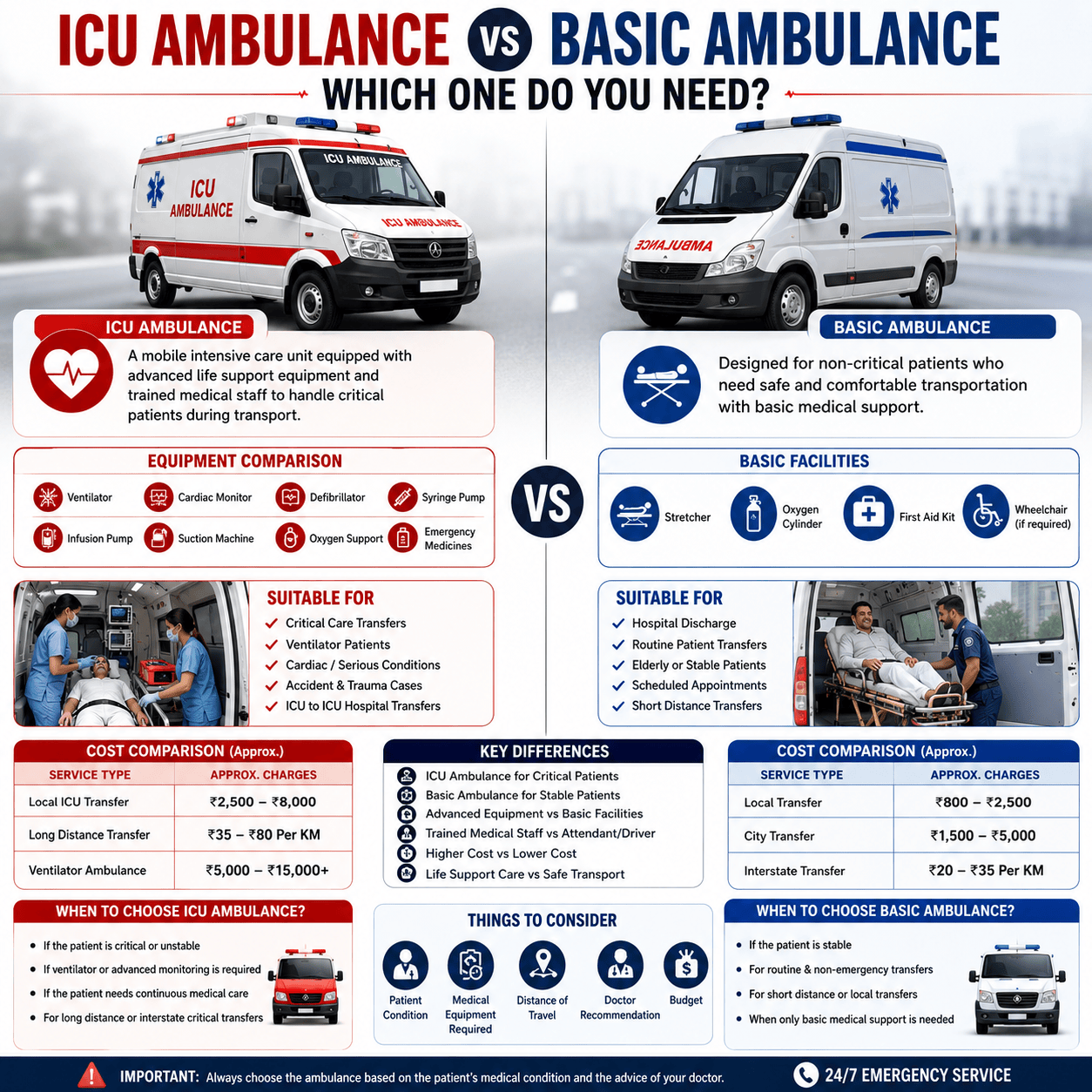

During a medical emergency, choosing the right ambulance can significantly impact patient safety. However, many families are unsure whether they need a Basic Ambulance or an ICU Ambulance. As a result, they often book the wrong vehicle and face challenges during transportation.
Both ambulance types serve different medical needs. A Basic Ambulance is suitable for stable patients who need transportation between locations. On the other hand, an ICU Ambulance is designed for critically ill patients who require continuous monitoring and advanced life support.
Therefore, understanding the difference between these ambulance types helps families make informed decisions during emergencies.
This guide explains the features, costs, equipment, advantages, and situations where each ambulance is appropriate.
What Is a Basic Ambulance?
A Basic Ambulance, also known as a Patient Transfer Ambulance, is designed for non-critical patients.
It provides essential transportation support and basic medical equipment.
Equipment Available in a Basic Ambulance
- Stretcher
- Oxygen Cylinder
- First Aid Kit
- Wheelchair (if required)
- Basic Medical Supplies
Suitable For
- Hospital Discharge
- Routine Patient Transfers
- Elderly Patient Transportation
- Scheduled Medical Appointments
- Non-Emergency Transfers
A Basic Ambulance focuses on safe transportation rather than advanced medical care.
What Is an ICU Ambulance?
An ICU Ambulance functions as a mobile intensive care unit.
It contains advanced medical equipment and trained medical professionals who can manage critical situations during transportation.
Equipment Available in an ICU Ambulance
- Ventilator
- Cardiac Monitor
- Defibrillator
- Syringe Pumps
- Infusion Pumps
- Emergency Medicines
- Oxygen Support System
- Suction Machine
Medical Staff Available
- Critical Care Paramedic
- Emergency Medical Technician
- Nurse (if required)
- Doctor (for specific cases)
ICU Ambulances provide hospital-level care while transporting the patient.
ICU Ambulance vs Basic Ambulance: Quick Comparison
| Feature | Basic Ambulance | ICU Ambulance |
|---|---|---|
| Patient Condition | Stable | Critical |
| Oxygen Support | Basic | Advanced |
| Ventilator | No | Yes |
| Cardiac Monitor | No | Yes |
| Defibrillator | No | Yes |
| Medical Staff | Driver / Attendant | Critical Care Team |
| Emergency Treatment | Limited | Advanced |
| Cost | Lower | Higher |
| Best For | Routine Transfers | Critical Patients |
When Do You Need a Basic Ambulance?
A Basic Ambulance is suitable when the patient is medically stable.
Common Situations
Hospital Discharge
Patients returning home after treatment.
Routine Transfers
Transfers between hospitals or healthcare facilities.
Elderly Patient Transportation
Transportation for checkups and scheduled appointments.
Mobility Assistance
Patients who cannot travel comfortably in a private vehicle.
Example
An elderly patient discharged after a minor surgery may only require a Basic Ambulance.
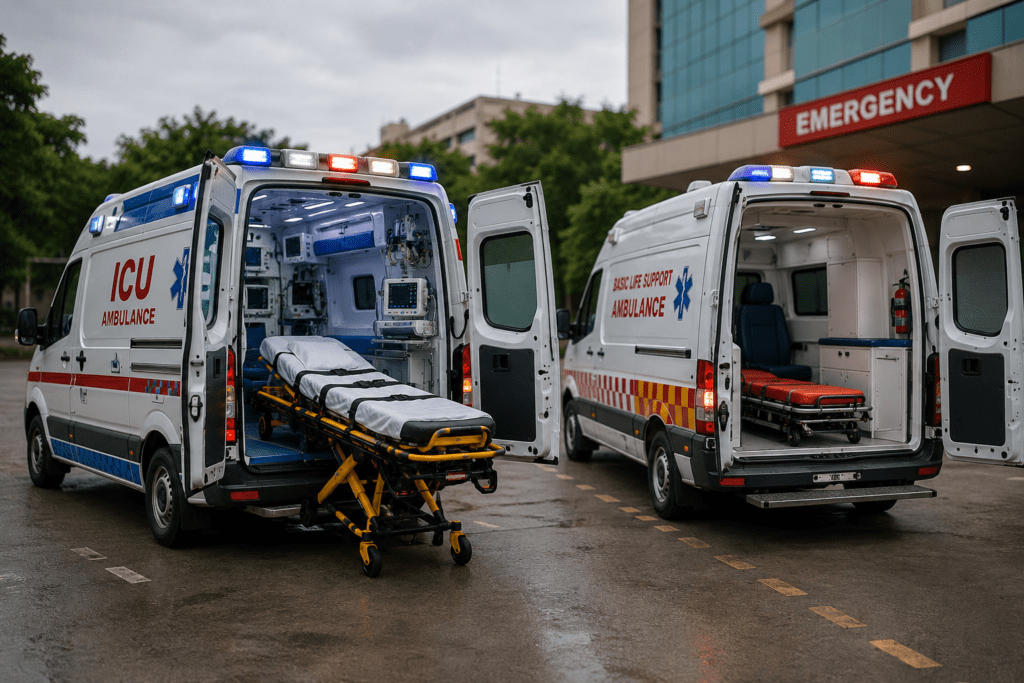
When Do You Need an ICU Ambulance?
An ICU Ambulance is necessary when the patient requires continuous medical supervision.
Common Situations
Ventilator Support
Patients dependent on ventilators during transportation.
Cardiac Patients
Individuals recovering from serious heart conditions.
Critical Care Transfers
ICU-to-ICU hospital transfers.
Serious Accident Cases
Patients requiring emergency monitoring.
Organ Failure Cases
Patients receiving intensive treatment.
Example
A patient on a ventilator being transferred from Jaipur to Delhi requires an ICU Ambulance.
Equipment Comparison
Basic Ambulance Equipment
| Equipment | Available |
|---|---|
| Stretcher | Yes |
| Oxygen Cylinder | Yes |
| First Aid Kit | Yes |
| Wheelchair | Sometimes |
| Monitoring Equipment | Limited |
ICU Ambulance Equipment
| Equipment | Available |
|---|---|
| Ventilator | Yes |
| Cardiac Monitor | Yes |
| Defibrillator | Yes |
| Syringe Pump | Yes |
| Infusion Pump | Yes |
| Suction Machine | Yes |
| Emergency Medicines | Yes |
Cost Comparison
Ambulance charges depend on distance, city, and equipment requirements.
Basic Ambulance Charges
| Service Type | Approximate Cost |
|---|---|
| Local Transfer | ₹800 – ₹2,500 |
| City Transfer | ₹1,500 – ₹5,000 |
| Interstate Transfer | ₹20 – ₹35 Per KM |
ICU Ambulance Charges
| Service Type | Approximate Cost |
|---|---|
| Local ICU Transfer | ₹2,500 – ₹8,000 |
| Long Distance Transfer | ₹35 – ₹80 Per KM |
| Ventilator Ambulance | ₹5,000 – ₹15,000+ |
Actual costs vary depending on medical requirements.
Risks of Choosing the Wrong Ambulance
Choosing an inappropriate ambulance can create serious challenges.
Common Problems
- Insufficient medical support
- Lack of monitoring equipment
- Delayed emergency intervention
- Increased health risks during transport
Therefore, always discuss the patient’s condition before booking.
Questions to Ask Before Booking an Ambulance
Is the patient stable?
Stable patients generally require Basic Ambulances.
Does the patient require oxygen?
Some cases need oxygen-equipped ambulances.
Is a ventilator required?
Ventilator-dependent patients need ICU Ambulances.
Is medical monitoring necessary?
Critical patients require continuous monitoring.
What is the travel distance?
Long-distance transfers may require advanced support.
Advantages of ICU Ambulances
Continuous Monitoring
Medical staff monitor vital signs throughout the journey.
Emergency Intervention
Immediate treatment can be provided if needed.
Advanced Equipment
Hospital-level equipment remains available.
Safer Long-Distance Transfers
Suitable for interstate transportation.
Advantages of Basic Ambulances
Affordable
Lower transportation costs.
Easily Available
Available in most cities.
Suitable for Routine Transfers
Ideal for stable patients.
Faster Booking Process
Minimal medical assessment required.
Why Professional Ambulance Services Matter
Professional ambulance providers ensure:
- Trained Staff
- Proper Equipment
- Timely Response
- Safe Transportation
- Transparent Pricing
Consequently, patients receive appropriate care during transit.
Why Choose Heaven Gate Ambulance Service?
Heaven Gate Ambulance Service provides both Basic and ICU Ambulances across Jaipur and India.
Our Services
- Basic Ambulance
- Oxygen Ambulance
- ICU Ambulance
- Ventilator Ambulance
- Patient Transfer Ambulance
- Long-Distance Ambulance
Why Families Trust Us
- Available 24×7
- Fast Response
- Experienced Medical Team
- Transparent Pricing
- Nationwide Coverage
We help patients reach their destination safely and comfortably.
Frequently Asked Questions (FAQs)
What is the difference between an ICU Ambulance and a Basic Ambulance?
A Basic Ambulance provides transportation for stable patients, while an ICU Ambulance offers advanced life-support equipment and medical monitoring.
When should I book an ICU Ambulance?
You should book an ICU Ambulance for critically ill patients, ventilator cases, and ICU transfers.
Is oxygen available in a Basic Ambulance?
Yes. Most Basic Ambulances include oxygen support.
Are ICU Ambulances expensive?
Yes. ICU Ambulances cost more due to advanced equipment and medical staff.
Can ICU Ambulances travel between states?
Yes. They are commonly used for interstate patient transfers.
Is a doctor available in an ICU Ambulance?
Doctors can be arranged when medically required.
Which ambulance is best for elderly patients?
Stable elderly patients generally require a Basic Ambulance.
Contact Heaven Gate Ambulance Service
Need help choosing the right ambulance?
📞 Call: 9024369206
📱 WhatsApp: 9024369206
🌐 Website: www.heavengate.in
Available 24×7 For:
- Basic Ambulance
- ICU Ambulance
- Ventilator Ambulance
- Oxygen Ambulance
- Patient Transfer Services
- Interstate Ambulance Transfers
Fast Response • Professional Care • 24×7 Support