

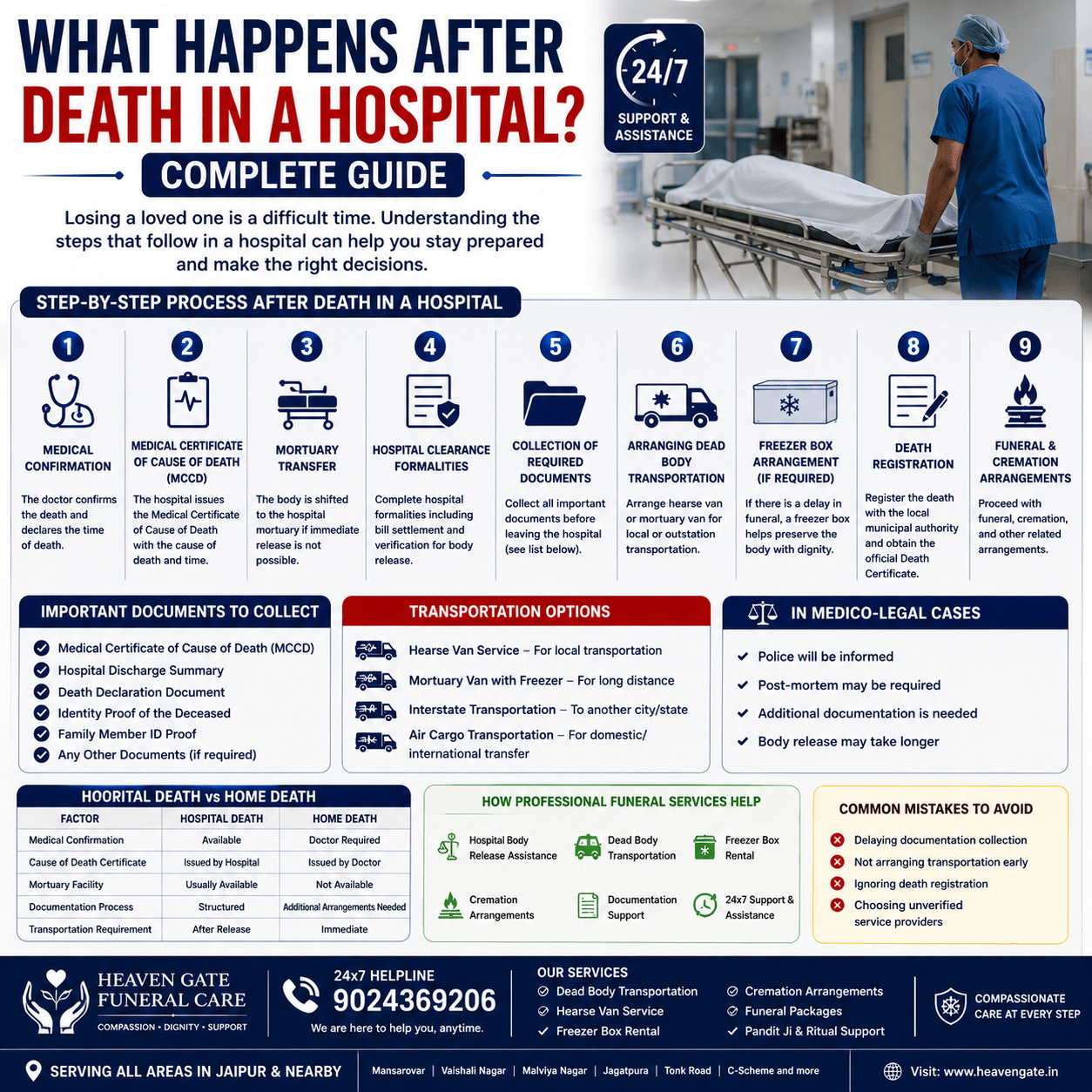

The death of a loved one in a hospital is one of the most difficult moments a family can face. During this emotional time, many families feel confused about the next steps. They often do not know which documents are required, how to claim the body, or how to arrange transportation and funeral services.
Fortunately, hospitals follow a standard process after a death occurs. Moreover, professional funeral service providers can help families manage documentation, transportation, freezer box arrangements, and cremation services.
Understanding what happens after death in a hospital can reduce stress and help families make informed decisions. Therefore, this guide explains every step involved, from medical confirmation to the final funeral arrangements.
What Happens Immediately After Death in a Hospital?
When a patient passes away, the attending doctor first confirms the death.
The hospital then follows specific medical and legal procedures.
Initial Steps
- Medical staff confirm the death.
- The doctor records the time of death.
- Family members are informed.
- The hospital prepares medical documentation.
Afterward, the body is shifted to the hospital mortuary if immediate release is not possible.

Step 1: Medical Confirmation of Death
A qualified doctor must officially declare the death.
The doctor examines:
- Pulse
- Breathing
- Heart activity
- Other vital signs
Once confirmed, the hospital records the death in its system.
Step 2: Issuance of Medical Certificate of Cause of Death (MCCD)
One of the most important documents is the Medical Certificate of Cause of Death.
This certificate includes:
- Name of the deceased
- Date and time of death
- Cause of death
- Hospital details
Families need this document for further procedures.
Step 3: Mortuary Transfer
If the family requires additional time, the hospital may move the body to the mortuary.
A mortuary helps preserve the body temporarily.
However, some hospitals charge additional mortuary fees after a certain period.
Step 4: Hospital Clearance Formalities
Before releasing the body, hospitals generally complete:
Administrative Formalities
- Settlement of hospital bills
- Discharge documentation
- Verification of family details
- Record completion
Once completed, the body can be released.
Step 5: Collection of Required Documents
Families should collect all important documents before leaving the hospital.
Essential Documents
- Medical Certificate of Cause of Death (MCCD)
- Hospital Discharge Summary
- Death Declaration Document
- Identity Proof of the Deceased
- Family Member ID Proof
Keep multiple copies for future use.
Step 6: Arranging Dead Body Transportation
After hospital clearance, families need transportation arrangements.
Available Transportation Options
Hearse Van Service
Suitable for local transportation.
Mortuary Van with Freezer Box
Ideal for longer journeys.
Interstate Transportation
Used when the final rites will occur in another city.
Air Cargo Transportation
Required for long-distance domestic or international transfers.
Internal Link Opportunity
Read:
Dead Body Transportation Near Me: Complete Guide
Step 7: Freezer Box Arrangement (If Required)
Sometimes relatives need time to arrive.
Therefore, families may rent a freezer box to preserve the body.
A freezer box helps:
- Maintain dignity
- Prevent decomposition
- Allow time for funeral planning
Internal Link Opportunity
Read:
Freezer Box Near Me in Jaipur
Step 8: Death Registration
The death must be officially registered with the local municipal authority.
The registration process generally requires:
- Medical Certificate of Cause of Death
- Identity Documents
- Application Form
After registration, the official Death Certificate is issued.
Step 9: Funeral and Cremation Arrangements
Families can then proceed with funeral arrangements.
Common Services Required
- Hearse Van
- Cremation Ground Booking
- Pandit Ji Services
- Funeral Materials
- Prayer Meeting Arrangements
Internal Link Opportunities
- Best Cremation Grounds in Jaipur
- Electric Cremation in Jaipur: Complete Guide
- Funeral Package Cost in Jaipur
What Happens in Medico-Legal Cases?
Certain deaths require additional legal procedures.
Examples include:
- Road accidents
- Suicide cases
- Unnatural deaths
- Criminal investigations
In such situations:
- Police are informed.
- Post-mortem examination may be required.
- Additional documentation is needed.
- Body release may take longer.
Families should cooperate with hospital and police authorities.
Hospital Death vs Home Death
| Factor | Hospital Death | Home Death |
|---|---|---|
| Medical Confirmation | Available | Doctor Required |
| Cause of Death Certificate | Issued by Hospital | Issued by Doctor |
| Mortuary Facility | Usually Available | Not Available |
| Documentation Process | Structured | Additional Arrangements Needed |
| Transportation Requirement | After Release | Immediate |
Common Mistakes Families Should Avoid
Delaying Documentation Collection
Always collect hospital documents before leaving.
Not Arranging Transportation Early
Transportation should be planned immediately.
Ignoring Death Registration
Death registration is legally required.
Choosing Unverified Service Providers
Professional providers offer safer and more reliable support.
How Professional Funeral Services Help
Professional funeral service providers assist with:
- Hospital Body Release
- Transportation Arrangements
- Freezer Box Rental
- Cremation Coordination
- Documentation Support
As a result, families receive complete assistance during difficult times.
Why Choose Heaven Gate Funeral Care?
Heaven Gate Funeral Care provides complete funeral support after hospital death.
Our Services
- Dead Body Transportation
- Hearse Van Service
- Freezer Box Rental
- Cremation Arrangements
- Funeral Packages
- Documentation Assistance
- Interstate Transportation
Why Families Trust Us
- Available 24×7
- Fast Response
- Professional Team
- Transparent Pricing
- End-to-End Funeral Support
We help families arrange a dignified farewell with compassion and care.
Frequently Asked Questions (FAQs)
1. What document is issued after death in a hospital?
The hospital issues the Medical Certificate of Cause of Death (MCCD).
2. How long can a hospital keep a body?
The duration varies by hospital policy and mortuary availability.
3. Can a body be released immediately?
Yes, once documentation and hospital formalities are completed.
4. Is a death certificate issued by the hospital?
The hospital provides the medical cause of death certificate. The official death certificate is issued by the municipal authority.
5. Can transportation be arranged directly from the hospital?
Yes. Hearse vans and mortuary vans can pick up the body directly from the hospital.
6. Is a freezer box required?
It is helpful when funeral arrangements are delayed or relatives are travelling.
7. Are funeral services available 24×7?
Yes. Professional funeral service providers offer round-the-clock assistance.
Contact Heaven Gate Funeral Care
Need immediate assistance after a hospital death?
📞 Call: 9024369206
📱 WhatsApp: 9024369206
🌐 Website: heavengate.in
Available 24×7 for:
- Hospital Body Release Assistance
- Dead Body Transportation
- Hearse Van Service
- Freezer Box Rental
- Cremation Arrangements
- Funeral Support Services
Compassion • Dignity • Complete Support