

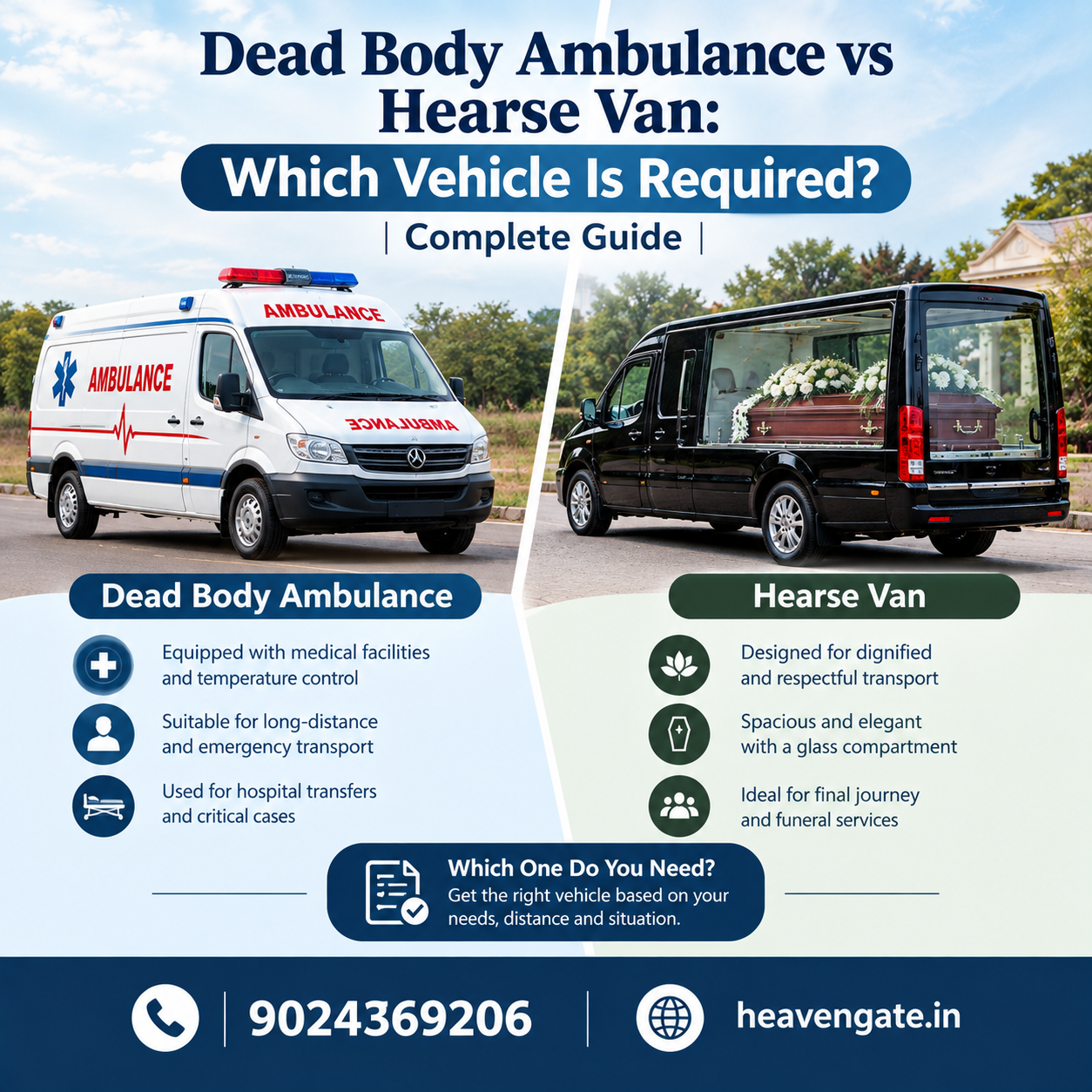

After a death, families often need to move the deceased quickly. However, many people are unsure which vehicle they should book.
Should they choose a dead body ambulance? Or should they arrange a hearse van?
The answer depends on the situation.
A medical ambulance primarily supports patients who need medical care or monitoring. A hearse van, on the other hand, serves funeral and dead body transportation needs.
Therefore, families should select the vehicle according to the transportation requirement.
This guide explains the difference between a dead body ambulance and hearse van. It also covers cost, documents, vehicle features, city services, and the booking process.
What Is a Dead Body Ambulance?
People often use the term dead body ambulance for a vehicle that transports a deceased person.
However, the exact vehicle setup can vary between providers.
Some providers use modified ambulance-style vehicles for funeral transportation. Others provide dedicated mortuary vehicles or hearse vans.
Therefore, families should ask the provider what type of vehicle they will receive before booking.
A vehicle intended for a deceased person should provide suitable space and secure handling throughout the journey.
What Is a Hearse Van?
A hearse van is a vehicle designed for transporting a deceased person.
Families commonly use hearse vans for:
- Hospital to home transportation
- Hospital to cremation ground
- Home to funeral location
- Local city transportation
- Intercity transportation
- Interstate dead body transportation
- Airport to home transportation
Unlike a medical ambulance, a hearse van does not primarily provide emergency medical care.
Instead, it focuses on respectful funeral transportation.
For local and intercity requirements, families can explore Hearse Van Service in Jaipur as part of their funeral transportation planning.
Dead Body Ambulance vs Hearse Van: Key Difference
The main difference comes down to the purpose of the vehicle.
| Feature | Dead Body Ambulance | Hearse Van |
|---|---|---|
| Main purpose | Transportation of deceased person | Funeral and deceased-person transportation |
| Medical treatment | Generally not required | Not provided |
| Funeral use | Possible | Common |
| Cremation-ground transfer | Possible | Common |
| Hospital transfer | Common | Common |
| Long-distance use | Depends on vehicle | Yes |
| Refrigeration | Depends on vehicle | Depends on vehicle |
| Medical equipment | Depends on provider | Usually not the focus |
| Best suited for | Situations requiring ambulance-style transport | Funeral transportation |
The terminology can vary between service providers.
Therefore, always confirm the vehicle specifications before booking.
When Should You Choose a Hearse Van?
A hearse van generally suits families who need funeral transportation after a death.
You may choose a hearse van when:
- The deceased needs transportation from a hospital.
- The family needs to take the deceased home.
- The deceased needs to reach the native place.
- The funeral will take place in another city.
- The body needs transportation to a cremation ground.
- Interstate transportation is required.
- Airport pickup requires funeral transportation.
For example, a family may need a hearse van from Jaipur to Delhi.
Similarly, families may arrange transportation from Jaipur to Ajmer, Kota, Udaipur, Ahmedabad, or other destinations.
When Is an Ambulance More Appropriate?
A medical ambulance becomes more appropriate when the person is alive and needs medical support during transportation.
For example, a patient may require:
- Oxygen support
- Medical monitoring
- Paramedic assistance
- Emergency transportation
- ICU-level support
In such situations, families should arrange an appropriate medical ambulance.
A hearse van should not replace an emergency medical ambulance for a living patient.
What If the Person Has Just Passed Away?
The next step depends on where the death occurred.
Death in a Hospital
The hospital usually completes the required medical formalities first.
After the hospital releases the deceased, the family can arrange transportation.
At this stage, a hearse van or suitable mortuary vehicle may become appropriate.
Death at Home
The family may first need medical confirmation of death.
The required procedure can depend on the circumstances.
Once the necessary formalities are complete, the family can arrange transportation.
If the body must travel to another city, discuss the vehicle type before dispatch.
Accidental or Medico-Legal Death
Accidental and other medico-legal cases can involve additional procedures.
Police or other authorities may need to complete formalities before release.
Therefore, families should follow instructions from the hospital and investigating authority.
Do not move the deceased before the responsible authority permits transportation.
Is a Refrigerated Mortuary Van Better for Long-Distance Travel?
A refrigerated mortuary van can be useful for longer journeys.
Temperature-controlled transportation can help support preservation during extended travel.
For example, families travelling from Jaipur to Mumbai may need a different vehicle setup than families travelling from Jaipur to Ajmer.
The same applies to routes such as:
- Delhi to Jaipur
- Mumbai to Ahmedabad
- Hyderabad to Bangalore
- Chennai to Bangalore
- Kolkata to Delhi
- Ahmedabad to Mumbai
However, the provider should assess the journey before recommending the vehicle.
Hearse Van vs Mortuary Van
People also confuse these two terms.
A hearse van mainly refers to a funeral transportation vehicle.
A mortuary van may include refrigeration or temperature-control equipment for preservation during transportation.
Therefore, the two terms can describe different vehicle features.
Before booking, ask:
- Is the vehicle refrigerated?
- Does it have a dedicated body compartment?
- Is the vehicle suitable for long-distance travel?
- Are tolls included?
- Are waiting charges included?
- Is the driver experienced with funeral transportation?
These questions can help families choose the appropriate option.
Dead Body Transportation Cost
The cost depends on the route and vehicle.
Common factors include:
- Distance
- Vehicle type
- Refrigeration
- Fuel
- Toll charges
- Driver allowance
- Waiting time
- Night-time booking
- Emergency dispatch
- Preservation requirements
Therefore, providers usually quote the final price after checking the complete journey.

Documents Required for Hearse Van Transportation
The required documents depend on the circumstances.
Families should generally keep available:
- Death certificate
- Medical cause of death documentation
- Deceased person’s identity proof
- Family member’s identity proof
- Hospital release documents
- Post-mortem documents, when applicable
- Police documents, when applicable
Not every case requires every document.
Therefore, confirm the requirements with the hospital, police authority, and transportation provider.
Is Embalming Required for a Hearse Van?
Embalming does not automatically apply to every domestic road journey.
However, families may consider embalming for long-distance transportation.
It may also become relevant when the deceased will later travel by air.
Airlines can have separate requirements for transporting human remains.
Therefore, families should confirm the requirements before making arrangements.
Can a Hearse Van Transport a Body Between States?
Yes, interstate transportation can be arranged by road.
For example, families may require:
- Jaipur to Delhi
- Jaipur to Ahmedabad
- Jaipur to Indore
- Delhi to Jaipur
- Mumbai to Pune
- Ahmedabad to Mumbai
- Hyderabad to Bangalore
However, documentation and local procedures can vary.
Therefore, the provider should review the route before dispatch.
Dead Body Ambulance vs Hearse Van for Airport Transportation
Airport transportation involves additional planning.
If the deceased needs to travel by air, families may need to arrange:
- Required medical documents
- Embalming, where required
- Airline approval and cargo arrangements
- Appropriate coffin or container
- Airport documentation
- Hearse or mortuary van for airport transfer
The road vehicle takes the deceased to the airport.
The airline or cargo operator then handles the air transportation process.
After arrival, another hearse or mortuary vehicle can collect the deceased from the destination airport.
How to Choose the Right Vehicle?
Ask these questions before booking.
1. Is the person alive?
If yes, a medical ambulance may be required.
If the person has passed away, funeral transportation becomes relevant.
2. How far is the destination?
Short city transfers may need a standard hearse van.
Long-distance journeys may require a refrigerated mortuary vehicle.
3. How long will the journey take?
Long travel times may require additional preservation planning.
Discuss this with the transportation provider.
4. Does the family need refrigeration?
If yes, specifically request a refrigerated mortuary van.
Do not assume every hearse van has refrigeration.
5. Is the journey interstate?
If yes, confirm the required documents and route arrangements before dispatch.
Step-by-Step Hearse Van Booking Process
Step 1: Share the Pickup Location
Provide the exact hospital, home, mortuary, or other pickup address.
Step 2: Share the Destination
Give the complete destination address.
Step 3: Explain the Situation
Tell the provider whether the death occurred at home, in a hospital, or in another location.
Also mention if the case involves police or post-mortem formalities.
Step 4: Discuss Vehicle Requirements
Ask whether you need:
- Hearse van
- Mortuary van
- Refrigerated vehicle
- Long-distance funeral vehicle
Step 5: Confirm Documents
Keep the available documents ready.
The provider can identify any additional requirements.
Step 6: Confirm the Price
Ask for a clear quotation.
Check tolls, waiting, parking, and other possible charges.
Step 7: Arrange Pickup
After confirmation, the vehicle can be dispatched.
Step 8: Complete Destination Handover
The deceased is handed over to the family or authorized representative at the destination.
Dead Body Transportation Services in Jaipur
Jaipur families can require funeral transportation for both local and long-distance journeys.
Common routes include:
- Jaipur to Delhi
- Jaipur to Ajmer
- Jaipur to Kota
- Jaipur to Udaipur
- Jaipur to Ahmedabad
- Jaipur to Indore
- Jaipur to Mumbai
Heaven Gate provides transportation coordination for families requiring Dead Body Transportation in Jaipur.
Families can also explore:
- Hearse Van Service in Jaipur
- Mortuary Van Service in Jaipur
- Dead Body Freezer Box Service
- Cremation Services in Jaipur
- Funeral Services in Jaipur
These service pages can support the broader funeral transportation journey.
Internal Linking Suggestions
Service Pages
Related Blog Posts
Frequently Asked Questions
1. What is the difference between a dead body ambulance and a hearse van?
A medical ambulance primarily transports living patients who need medical support. A hearse van focuses on transporting a deceased person for funeral-related purposes.
2. Which vehicle should I use after a death?
After the required medical and legal formalities, families usually need a hearse van or suitable mortuary vehicle. The correct option depends on distance and preservation requirements.
3. Is a hearse van refrigerated?
Not every hearse van has refrigeration. Always confirm the vehicle’s specifications before booking.
4. Is a mortuary van better for long-distance transportation?
A refrigerated mortuary van may suit longer journeys because it can provide temperature-controlled transportation. The provider should assess the route before recommending the vehicle.
5. Can a hearse van travel between states?
Yes. Interstate dead body transportation can be arranged by road. However, documentation and local procedures can vary.
6. How much does a hearse van cost in Jaipur?
Local hearse van charges can vary based on distance, vehicle type, timing, and additional services. An indicative local range may start around ₹2,000 and increase with distance and requirements.
7. Can a hearse van take the deceased to an airport?
Yes. A hearse or suitable mortuary vehicle can transport the deceased to an airport for further air-cargo arrangements.
8. Is embalming required before road transportation?
Not for every domestic road journey. However, embalming may become appropriate for long-distance transportation or certain air-travel requirements.
9. What documents are needed for hearse van transportation?
Requirements can vary. Families should keep the death certificate, medical documents, identity documents, hospital release papers, and applicable police or post-mortem documents ready.
10. Can Heaven Gate arrange a hearse van in Jaipur?
Yes. Heaven Gate provides hearse van and dead body transportation support in Jaipur and for journeys to other Indian cities.