

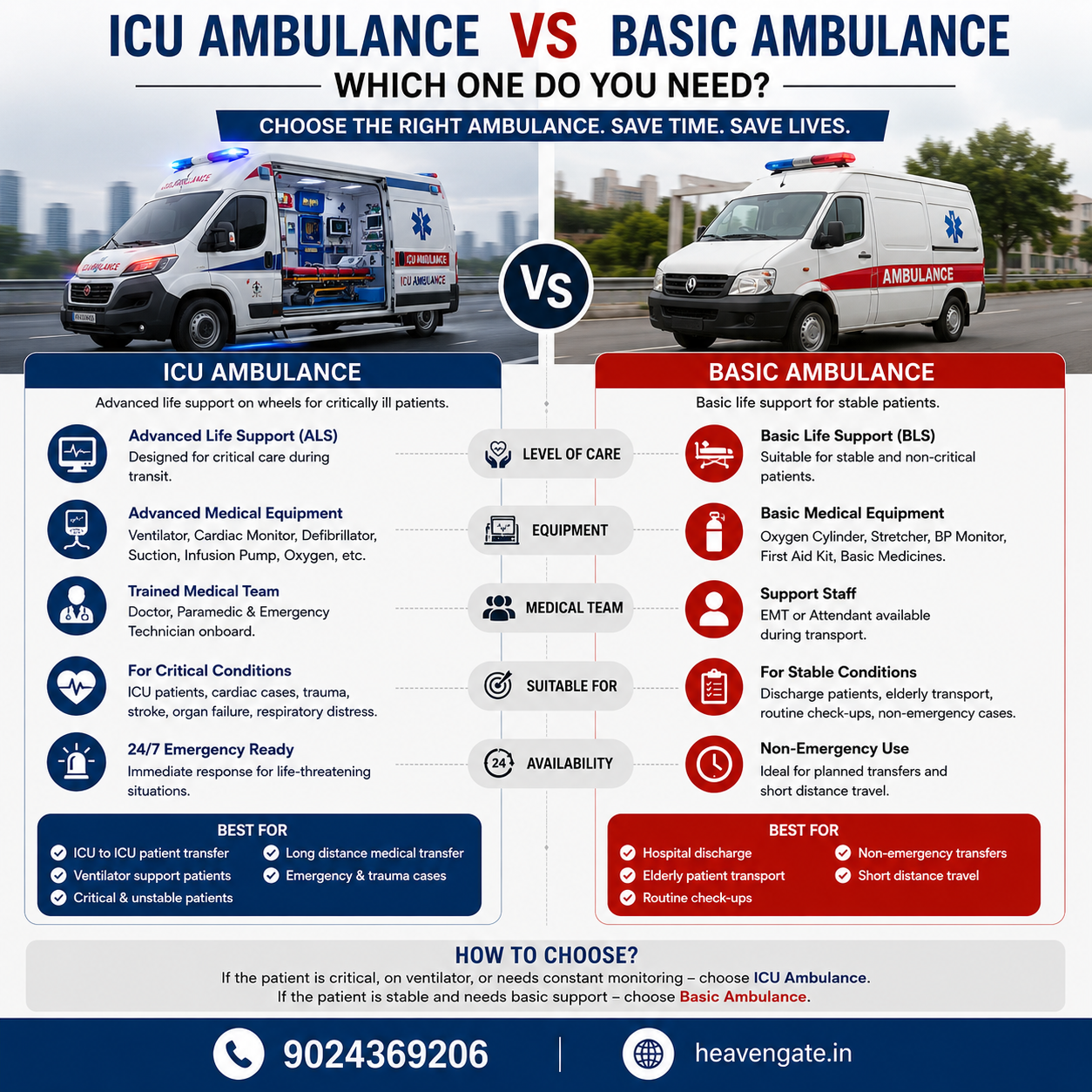

During a medical emergency, choosing the correct ambulance can directly affect patient safety. Many families feel confused about whether they need a Basic Ambulance or an ICU Ambulance. Although both transport patients, they serve very different medical needs.
This guide explains the difference between ICU and Basic Ambulance services, their equipment, staffing, ideal use cases, and how to select the right option for safe patient transportation across India.
Understanding the Two Ambulance Types
The primary difference lies in the level of medical care provided during transport.
Feature | Basic Ambulance | ICU Ambulance |
|---|---|---|
Patient condition | Stable | Critical |
Oxygen support | Yes | Advanced |
Ventilator | No | Yes |
Cardiac monitor | Limited | Yes |
Doctor onboard | Usually No | Yes |
ICU equipment | No | Yes |
Therefore, families should always choose the ambulance according to the patient’s medical condition rather than distance alone.
What Is a Basic Ambulance?
A Basic Ambulance, also known as Basic Life Support (BLS), is suitable for patients whose condition remains stable during transportation.
Typical Equipment
Oxygen cylinder
Stretcher
Wheelchair support
First-aid equipment
Blood pressure monitor
Basic emergency supplies
Best For
Hospital discharge
Non-emergency transfers
Elderly patient transportation
Routine medical appointments
Short-distance transfers
Consequently, BLS ambulances provide safe transportation without intensive medical intervention.
What Is an ICU Ambulance?
An ICU Ambulance functions as a mobile intensive care unit. It carries advanced life-support equipment along with trained critical care professionals.
ICU Equipment Includes
Ventilator
Cardiac monitor
Defibrillator
Syringe infusion pumps
Advanced oxygen system
Suction machine
Emergency medications
Medical Team
Most ICU ambulances include:
Critical care doctor
Trained paramedic
Emergency technician
As a result, critically ill patients continue receiving ICU-level care throughout the journey.
When Do You Need a Basic Ambulance?
Choose a Basic Ambulance when the patient:
Is medically stable
Does not require ventilator support
Needs oxygen only
Requires discharge transportation
Can travel safely without continuous ICU monitoring
Examples include post-surgery discharge, elderly transfers, and rehabilitation transport.
When Do You Need an ICU Ambulance?
An ICU Ambulance becomes essential if the patient has:
Ventilator dependency
Cardiac instability
Stroke
Severe trauma
ICU referral
Organ failure
Critical respiratory illness
In these situations, advanced monitoring and continuous medical supervision become extremely important.

Cost Difference Between ICU and Basic Ambulance
The pricing depends on several factors rather than one fixed amount.
Important factors include:
Distance travelled
City or state
Medical equipment required
Doctor availability
Ventilator support
Emergency timing
Therefore, families should request a personalized quotation before booking.
Cities Where ICU Ambulance Services Are Available
Professional ambulance services are available across major Indian cities, including:
Jaipur
Malviya Nagar
Jagatpura
Mansarovar
Vaishali Nagar
Delhi
South Delhi
Dwarka
Rohini
Mumbai
Andheri
Malad
Borivali
Other Cities
Ahmedabad
Varanasi
Bengaluru
Chennai
Hyderabad
Interstate ICU patient transportation is also available depending on medical requirements.
How to Choose the Right Ambulance
Before booking, discuss the patient’s condition with the treating doctor.
Choose Basic Ambulance If
Patient is conscious and stable.
No ventilator is required.
Oxygen support is minimal.
Routine transfer is planned.
Choose ICU Ambulance If
Patient is in ICU.
Continuous monitoring is necessary.
Ventilator support is required.
Critical medications must continue during travel.
Following medical advice ensures safer transportation.
Why Choose Heaven Gate Ambulance Services?
Heaven Gate provides reliable patient transportation with trained medical professionals.
Services include:
ICU Ambulance
Basic Ambulance
Ventilator Ambulance
Cardiac Ambulance
Emergency Patient Transfer
Interstate Medical Transportation
Hospital-to-Hospital Transfer
24/7 Ambulance Assistance
Furthermore, our team coordinates transportation quickly during medical emergencies.
Service Pages
- Freezer Box Service in Mumbai
- Dead Body Transportation Mumbai
- Hearse Van Service Mumbai
- Funeral Services Mumbai
- Cremation Services Mumbai
Related Blog Posts
- Freezer Box on Rent in Mumbai
- Dead Body Freezer Box Charges in Mumbai
- Freezer Box Service in Malad Mumbai
- Freezer Box Service in Andheri Mumbai
- Freezer Box Service in Sanganer Jaipur
- Freezer Box on Rent in Jaipur
- Cost of Domestic Dead Body Transportation in India
These internal links can help users find related services while improving website navigation.
Frequently Asked Questions
1. What is the difference between an ICU and Basic Ambulance?
A Basic Ambulance transports stable patients, while an ICU Ambulance provides advanced life-support equipment and continuous medical care.
2. Does an ICU Ambulance have a ventilator?
Yes. ICU ambulances carry ventilators along with cardiac monitors and other critical care equipment.
3. Can a Basic Ambulance transport oxygen patients?
Yes. Basic ambulances provide oxygen support for stable patients who do not require intensive care.
4. Is a doctor available in an ICU Ambulance?
Yes. Most ICU ambulances include a critical care doctor and trained paramedic.
5. Which ambulance is suitable for hospital discharge?
A Basic Ambulance is usually appropriate for medically stable discharge patients.
6. Can ICU Ambulances travel between states?
Yes. Interstate ICU patient transportation is available depending on the patient’s condition.
7. How is the ambulance cost calculated?
The quotation depends on distance, equipment, medical staff, and emergency requirements.
8. How do I book an ICU Ambulance?
Call or WhatsApp the ambulance team, share the patient’s condition, pickup location, destination, and treating doctor’s advice.