

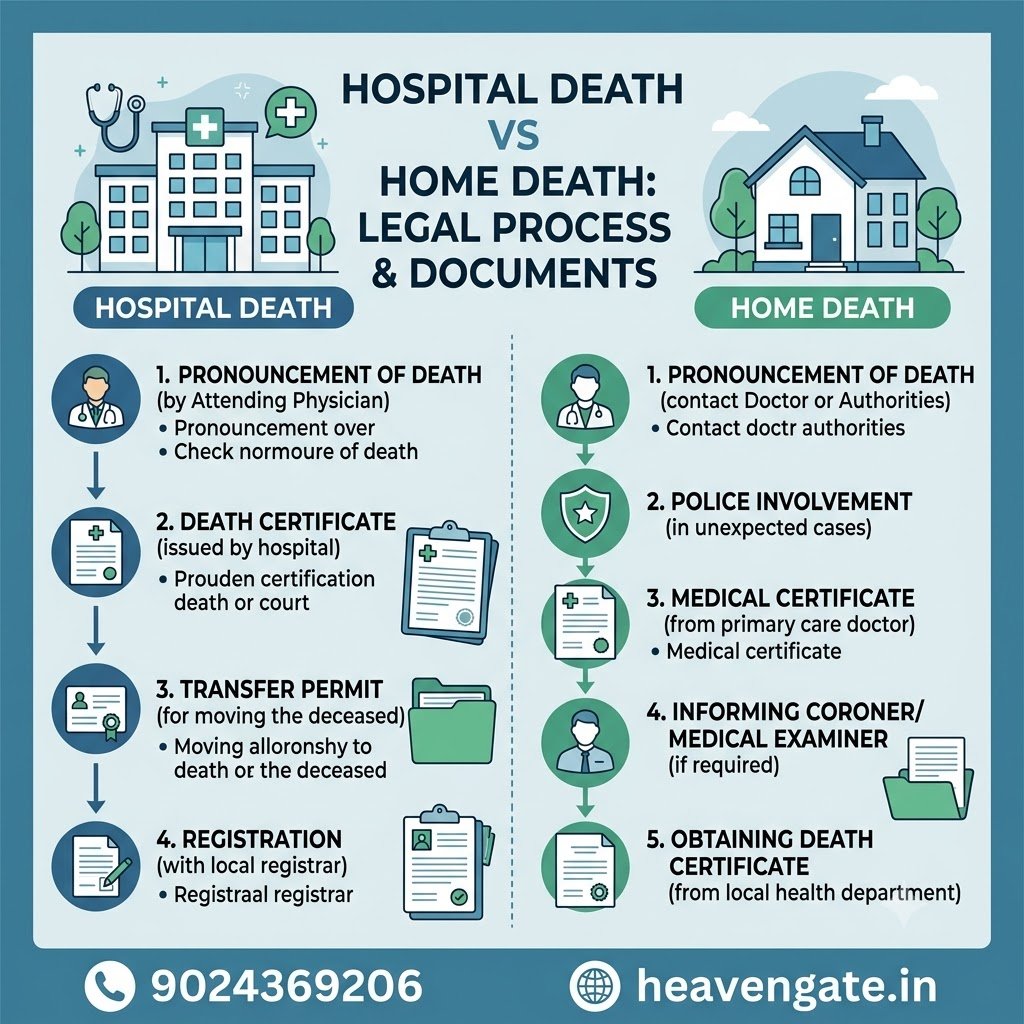

When a loved one passes away, families must manage funeral arrangements and legal formalities. However, the process can differ depending on whether the death occurs in a hospital or at home.
A hospital usually manages medical documentation and reports the death through its established process. In contrast, a family may need to contact a doctor and the local registration authority after a home death.
In both situations, families must follow the applicable death reporting and registration rules. They also need to understand when police involvement or a post-mortem examination may apply.
This guide explains the hospital death vs home death legal process in Rajasthan, including documents, registration steps, and practical guidance for families in Jaipur.
Hospital Death vs Home Death: What Is the Main Difference?
The main difference involves medical documentation, death reporting, and the authorities involved.
| Point | Hospital Death | Home Death |
|---|---|---|
| Initial assistance | Hospital medical team | Attending doctor or appropriate authority |
| Medical documentation | Hospital arranges applicable medical records | Doctor may provide medical certification when applicable |
| Death reporting | Hospital generally manages reporting for deaths occurring under its care | Eligible family member or informant follows the applicable reporting process |
| Police involvement | May apply in medico-legal or suspicious cases | May apply in sudden, unexplained, accidental, or suspicious cases |
| Registration authority | Registrar responsible for the place of death | Registrar responsible for the place of death |
| Death certificate | Authorised Registrar issues the official certificate | Authorised Registrar issues the official certificate |
Therefore, the location of death affects the initial procedure, but both situations require proper registration.
Rajasthan manages civil registration through its official Pehchan portal. The portal supports death registration, registration status checks, and certificate downloads. Source: National Informatics Centre.
1. Legal Process After a Hospital Death in Rajasthan
When a person dies in a hospital, the medical team usually guides the family through the initial formalities.
Step 1: Obtain Medical Confirmation
The attending doctor or authorised medical practitioner confirms the death according to the applicable medical procedure.
The hospital then explains which records and certificates the family can collect.
Step 2: Collect the Medical Documents
Ask the hospital administration for the relevant documents, such as:
Medical certificate of cause of death, where applicable
Hospital death summary or medical records
Discharge or death-related paperwork
Documents required for death registration
Police or medico-legal documents, if applicable
The exact paperwork depends on the circumstances.
For example, a death following hospital treatment may follow a different process from a patient who arrives at the emergency department already deceased. In brought-dead or medico-legal cases, the hospital may direct the family to the police or another competent authority.
Step 3: Complete Death Reporting
Hospitals generally handle the reporting process for deaths that occur under their care. The hospital’s designated staff coordinate with the relevant Registrar under the applicable rules.
However, families should confirm whether the hospital has completed the registration or whether they must submit additional information.
Step 4: Register the Death
The authorised Registrar records the death after receiving the required information and documents.
In Rajasthan, the registration office depends on the place where the death occurred. For instance, families in Jaipur should contact the relevant municipal registration unit or the hospital for guidance.
Step 5: Obtain the Official Death Certificate
Once the registration authority completes the registration, the family can access the eligible certificate through the official Pehchan portal.
Visit: https://pehchan.rajasthan.gov.in/
The portal supports digitally signed death certificates and online registration searches. Source: Rajasthan Pehchan.
2. Legal Process After a Home Death in Rajasthan
A home death may require additional coordination because a hospital does not automatically manage the entire process.
Step 1: Contact a Doctor or Appropriate Authority
If the deceased received medical care during the recent illness, contact the attending doctor about the required medical certification.
If the death was sudden, unexplained, accidental, or suspicious, contact the police or emergency services as appropriate. Do not move or disturb the scene when authorities need to investigate.
Step 2: Obtain Medical Certification Where Applicable
The attending medical practitioner may need to certify the cause of death under the applicable rules.
The Registration of Births and Deaths Act, 1969, sets out responsibilities relating to death notification and medical certification. The requirements depend on the circumstances and the relevant rules. Read the Act.
If no doctor attended the deceased during the last illness, the family should ask the local Registrar how to proceed. Do not assume that a private declaration alone will be sufficient.
Step 3: Prepare the Death Report
The eligible informant must provide the prescribed death information to the registration authority.
Rajasthan’s Pehchan guidance identifies Form 2 as the death report. The form records details such as the deceased’s name, date of death, place of death, and informant information. Source: Rajasthan Pehchan rules and forms.
Step 4: Contact the Correct Registrar
In Rajasthan, families generally report deaths to the registration authority responsible for the location where the death occurred.
According to the official Pehchan portal, urban registration offices operate through municipal bodies. Rural registration offices operate through designated Gram Panchayat or health facility units.
The portal advises families to report a death within 21 days to obtain the certificate free of charge under the stated process. If the family misses this period, additional requirements or fees may apply. Source: Rajasthan Pehchan portal.
Step 5: Obtain the Death Certificate
After the Registrar completes the registration, the family can search for and download the available certificate through Pehchan.
If the record does not appear, contact the registration office. The family may need to complete missing formalities or follow the delayed-registration procedure.
3. Documents Required After a Hospital Death
The hospital and registration authority may request different documents. Therefore, confirm the exact list before visiting an office.
Common documents include:
Medical certificate of cause of death, where applicable
Hospital death summary or relevant medical record
Prescribed death report or registration form
Deceased person’s name, age, and address details
Date and place of death
Informant’s contact details and identification, where required
Police or post-mortem documents for applicable cases
Keep copies of the documents and note any registration reference number the hospital provides.

4. Documents Required After a Home Death
For a home death, prepare the available information and ask the local Registrar about the prescribed requirements.
These may include:
Medical certificate of cause of death, where applicable
Completed death report or Form 2
Deceased person’s personal details
Date and place of death
Informant’s name, address, and contact details
Supporting medical documents, if available
Police or post-mortem records, where applicable
The Registrar may request further documents depending on the case. Therefore, confirm the list with the appropriate office rather than relying on a general checklist alone.
5. What Happens in a Sudden or Unnatural Death?
A sudden or unnatural death may require additional legal procedures.
For example, authorities may investigate deaths involving accidents, suspected suicide, violence, poisoning, or unexplained circumstances.
In these situations:
Contact the police or emergency services as appropriate.
Follow instructions from the investigating authorities.
Do not disturb the scene if an investigation may be necessary.
Complete the required medical or post-mortem procedures.
Follow the Registrar’s instructions for death registration.
A doctor may not be able to certify the final cause of death until the relevant examination or investigation is complete.
Important: Families should follow the instructions of the police, medical team, and competent authorities in medico-legal cases.
6. Who Issues the Official Death Certificate in Rajasthan?
The authorised Registrar of Births and Deaths or designated issuing authority issues the official death certificate after registration.
A doctor may certify the cause of death, but this medical document is different from the official registered death certificate.
Similarly, a hospital death summary or a family’s written statement does not automatically replace the official certificate.
Rajasthan’s Pehchan system supports digital registration and digitally signed certificates. Therefore, families should use the official portal or contact the responsible registration office if they need a certificate or correction. Source: National Informatics Centre.
7. How to Register a Death Online in Rajasthan
After completing the initial formalities, families can check the registration status online.
Follow These Steps
Open the Rajasthan Pehchan portal.
Select the registration search or certificate download service.
Enter the requested details, such as the registration number or mobile number, where supported.
Complete any verification steps shown on the portal.
Download the certificate if the record is available.
If the record does not appear, contact the hospital or the Registrar responsible for the place of death. The family may need to complete registration first.
For assistance with portal services, the Pehchan helpline is 1800-180-6785 during office hours. The official support email is pehchan.raj@gov.in. Source: NIC Pehchan.
8. What If the Family Delays Death Registration?
Families sometimes delay registration because relatives need to travel, funeral arrangements take time, or documents remain incomplete.
However, the family should contact the Registrar as soon as possible.
Rajasthan’s official portal explains that deaths reported within 21 days can follow its stated free-registration process. After that, late fees, permissions, affidavits, or other requirements may apply according to the delay and applicable rules.
For deaths reported after longer periods, the family should ask the Registrar which authority must approve the application.
Do not assume that the same process applies to every delayed case. The requirements can depend on the time elapsed and the documents available.
9. Funeral and Transportation Support in Jaipur
Alongside legal formalities, families may need help arranging transportation and funeral services.
Heaven Gate assists families with funeral-related services in Jaipur and nearby areas. These services can help coordinate transportation while families focus on medical paperwork and registration.
Explore these related service pages and guides:
The correct transportation option depends on the deceased’s condition, destination, and any instructions from the hospital or authorities.
Internal Linking Suggestions
Service Pages
Related Blog Posts
Frequently Asked Questions
1. What is the difference between a hospital death and a home death in Rajasthan?
A hospital usually manages initial medical documentation and death reporting for deaths under its care. After a home death, the family may need to contact the attending doctor and the local Registrar. Both situations require official death registration.
2. Who registers a death in Rajasthan?
The authorised Registrar of Births and Deaths or designated registration authority records the death and issues the official certificate. The responsible office depends on the location of the death.
3. What documents are required after a hospital death?
Common documents include the medical certificate of cause of death where applicable, hospital records, prescribed death report, and the deceased’s personal details. Additional police or post-mortem documents may apply in certain cases.
4. What should a family do after a death at home?
The family should contact the attending doctor where applicable and approach the relevant Registrar for the required reporting process. For sudden, unexplained, accidental, or suspicious deaths, contact the police or emergency services as appropriate.
5. Is a doctor’s certificate the same as an official death certificate?
No. A doctor may certify the cause of death. The authorised Registrar issues the official death certificate after registering the death.
6. How many days does a family have to register a death in Rajasthan?
The Rajasthan Pehchan portal states that families should report a death within 21 days to obtain the certificate free of charge under its stated process. Delayed cases may require additional formalities or fees.
7. Can I download a death certificate online in Rajasthan?
Yes. Once the death is registered and the record is available, families can use the official Pehchan portal to search for and download the digitally signed certificate.
8. Does every home death require a post-mortem?
No. The need for a post-mortem depends on the circumstances and the applicable legal requirements. Sudden, suspicious, accidental, or other medico-legal deaths may require police involvement and further examination.
9. Where should I register a death in Jaipur?
Contact the registration authority responsible for the place where the death occurred. In urban Jaipur, this generally means the relevant municipal registration office or the registration unit associated with the hospital.
10. Can Heaven Gate help with funeral transportation in Jaipur?
Heaven Gate provides funeral-related assistance, including hearse van service, mortuary van service, dead body transportation, and funeral coordination. For official death registration, families should contact the relevant Registrar or Rajasthan Pehchan support.