

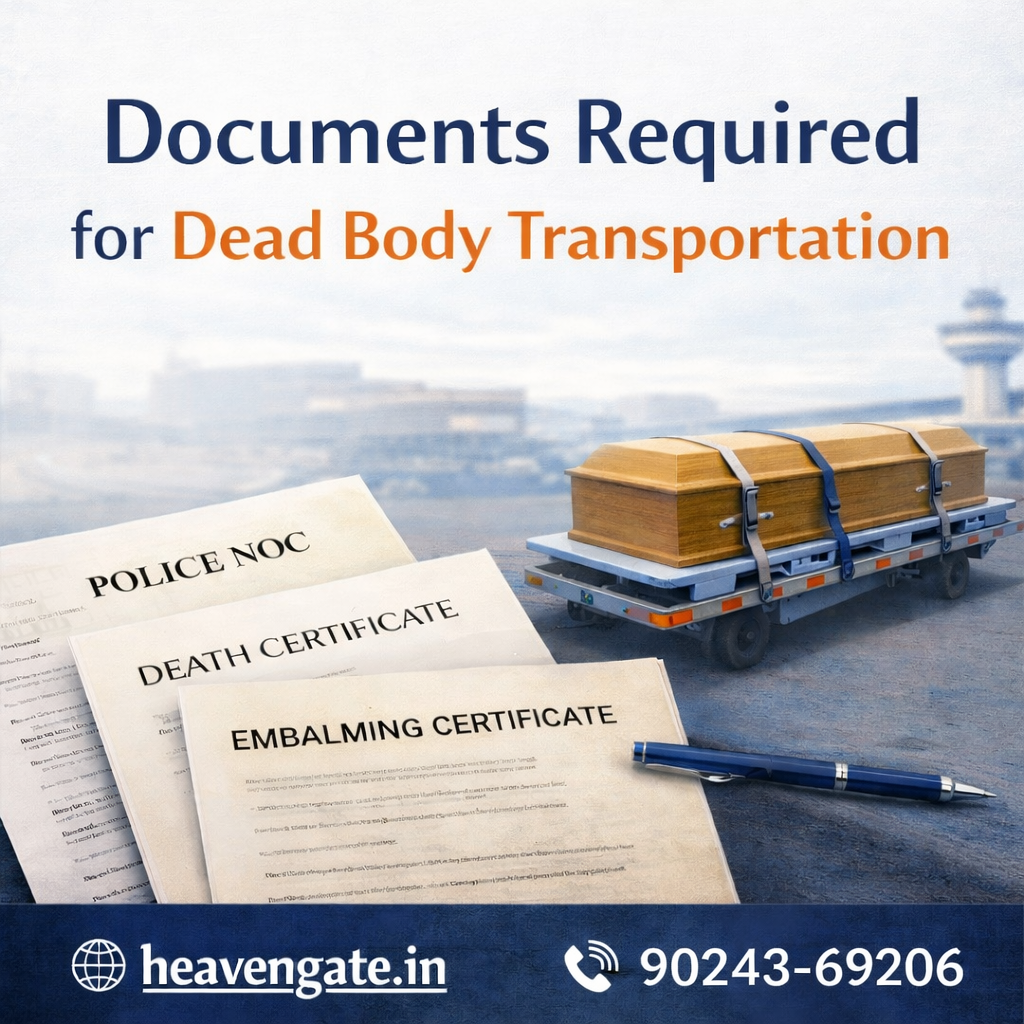

Transporting a deceased person is a sensitive and legally regulated process in India. Firstly, families must arrange the correct documents to avoid delays. Moreover, authorities verify these documents before allowing transportation by road or air.
Therefore, understanding the required paperwork helps families manage dead body transportation smoothly and respectfully.
Why Are Documents Important for Dead Body Transportation?
Documents confirm the identity of the deceased, the cause of death, and legal permission for transportation. As a result, hospitals, police departments, airlines, and local authorities rely on these documents to ensure lawful movement of the body.
List of Documents Required for Dead Body Transportation
1. Death Certificate
Firstly, the hospital or registered doctor issues the death certificate. This document officially confirms the death and mentions the cause and time.
Without this document, authorities do not allow transportation.
2. Police No Objection Certificate (NOC)
A police NOC is required only in specific cases, such as:
Accidental death
Unnatural or suspicious death
Death outside a hospital
However, police clearance is usually not required for natural deaths in hospitals.
3. Embalming Certificate
Next, authorized professionals issue an embalming certificate after preserving the body.
Mandatory for air transportation
Recommended for long-distance road transport
Moreover, airlines accept only embalmed bodies.
4. Government ID of the Deceased
Families must provide a valid government-issued ID, such as:
Aadhaar card
Passport
Voter ID
This document helps verify the identity of the deceased.
5. Coffin or Packing Declaration
Service providers issue a declaration confirming that:
The body is properly packed
Sealing follows safety guidelines
Therefore, this document ensures safe handling during transportation.
6. Airway Bill (For Air Transport)
For air transportation, airlines generate an airway bill after booking the cargo.
Additionally, authorities use this document for tracking and clearance at airports.

Additional Documents (Case-Specific)
In some cases, authorities may also ask for:
Hospital discharge summary
Post-mortem report (if conducted)
Local municipal clearance
As a result, families should keep all medical records ready.
Documents Required for Air vs Road Transportation
For Road Transportation
Death Certificate
Police NOC (if required)
ID proof of deceased
For Air Transportation
Death Certificate
Police NOC (if applicable)
Embalming Certificate
Coffin packing certificate
Airway bill
Therefore, air transport involves more documentation than road transport.
How Long Does Document Verification Take?
Natural death: 2–4 hours
Accidental death: 6–12 hours
Air cargo clearance: Same day or next available flight
However, incomplete documents can cause delays.
Common Mistakes to Avoid
Submitting photocopies instead of originals
Missing police clearance in accidental cases
Delaying embalming for air transport
Incorrect spelling in documents
Most importantly, double-check all documents before submission.
FAQs – Documents for Dead Body Transportation
1. Is a death certificate mandatory in all cases?
Yes, a death certificate is mandatory for any form of dead body transportation.
2. When is police NOC required?
Police NOC is required only for accidental or unnatural deaths.
3. Is embalming certificate needed for road transport?
Not always. However, it is mandatory for air transportation.
4. Can families arrange documents themselves?
Yes, but professional assistance can reduce stress and delays.
Conclusion
Finally, arranging the correct documents is the most important step in dead body transportation. By preparing certificates, police clearance (if required), and embalming records in advance, families can ensure smooth and dignified transportation of their loved ones.