

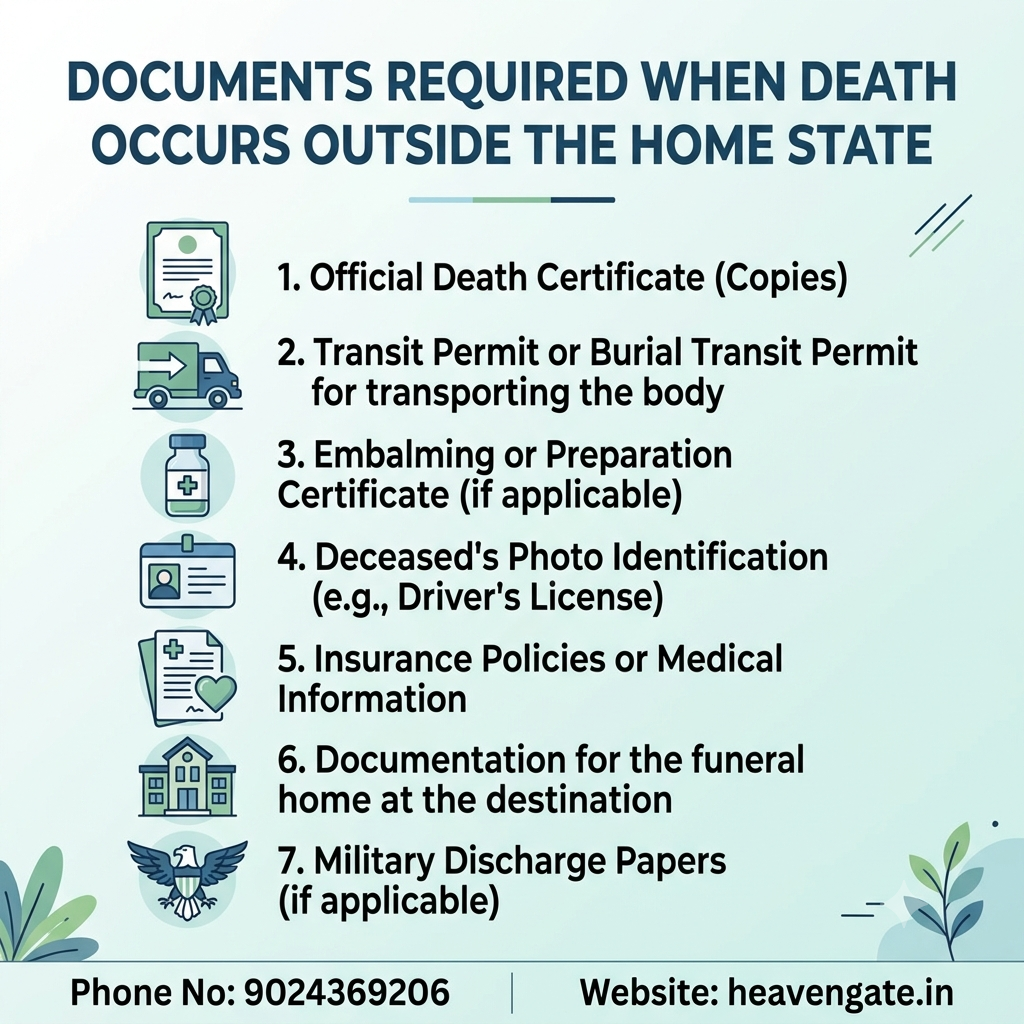

When a person dies outside their home state, the family may need to move the deceased to their hometown for the final rites. This process can involve hospitals, police authorities, local administration, ambulance providers, and funeral service teams.
The required documents depend on the cause of death, place of death, transportation method, and destination. Moreover, road and air transportation can have different requirements.
For example, a family may need dead body transportation from Jaipur to Delhi, Mumbai, Ahmedabad, Bengaluru, or another city. Therefore, preparing the paperwork early can help reduce delays.
This guide explains the important documents and steps involved in interstate dead body transportation in India.
What Does Interstate Dead Body Transportation Mean?
Interstate dead body transportation means moving a deceased person from one Indian state to another for burial or cremation.
For example:
- Jaipur, Rajasthan → Delhi
- Jaipur, Rajasthan → Mumbai, Maharashtra
- Jaipur, Rajasthan → Ahmedabad, Gujarat
- Delhi → Jaipur, Rajasthan
- Mumbai → Jaipur, Rajasthan
- Bengaluru → Jaipur, Rajasthan
Families can use a specialized dead body ambulance service for road transportation.
For longer distances, they may also consider air cargo, depending on airline acceptance and documentation.
Why Are Documents Important?
Documents help authorities confirm the identity and circumstances of the death.
They also support transportation, airport handling, and other formal procedures.
Furthermore, proper paperwork can help prevent unnecessary delays during interstate transportation.
The exact requirements can differ based on the situation. Therefore, families should confirm the documents with the hospital, police authorities, transport provider, and airline when applicable.
1. Death Certificate
The Death Certificate is one of the most important documents.
It officially records the death and provides key information about the deceased.
The document generally includes details such as:
- Full name
- Date of death
- Place of death
- Age or date of birth
- Cause of death, where applicable
- Registration details
For air transportation, airline and health authorities may require specific versions or supporting documents.
The Government of India’s eCARe guidance lists the Death Certificate among the mandatory documents for human-remains clearance when bringing remains into India from abroad.
For interstate road transportation, the family should keep multiple copies available.
2. Medical Certificate or Medical Cause of Death Certificate
A hospital or authorized medical practitioner may issue medical documentation related to the cause of death.
This document helps establish the medical circumstances surrounding the death.
The exact certificate can vary according to the hospital and local procedure.
Families should therefore ask the hospital which medical documents they must collect before moving the deceased.
A medical document can become particularly important when authorities need clarification about the cause of death.
3. Hospital Release Documents
If the person died in a hospital, the hospital may provide documents needed before release of the body.
These may include:
- Hospital death documents
- Medical records
- Body release authorization
- Identification documents
- Death summary
- Medical cause-of-death documentation
The hospital may also guide the family regarding the local registration process.
Therefore, families should complete hospital formalities before arranging the dead body ambulance service.
4. Police Documents
Police documentation can become important when the death involves an accident, injury, suicide, suspicious circumstances, or another unnatural cause.
Depending on the case, authorities may require documents such as:
- Police report
- Post-mortem documents
- Police clearance or release
- Identification records
- Investigation-related documents
The Government of India’s guidance for transportation of mortal remains also describes police reporting and medical documentation in cases involving transportation from abroad.
For interstate transportation, the local authorities should confirm whether any police clearance is necessary.
5. Post-Mortem Report
A post-mortem may apply when the death occurs under circumstances that require investigation.
For example, authorities may require a post-mortem after:
- Road accidents
- Workplace accidents
- Unexplained deaths
- Certain injury-related deaths
- Other medico-legal cases
If a post-mortem takes place, the family should ask the hospital or police authority about the documents required for releasing and transporting the body.
A transport provider should not assume that the same paperwork applies to every case.
6. Identity Proof of the Deceased
The family should keep an identity document of the deceased.
Depending on the situation, this may include:
- Aadhaar Card
- Passport
- Driving Licence
- Voter ID
- Other government-issued identification
The exact requirement depends on the authority handling the case.
For international transportation, passport documentation becomes especially important. India’s eCARe system specifically requires the deceased person’s cancelled passport for mandatory human-remains clearance applications.
7. Identity Proof of the Family Member
The person arranging transportation may also need identification.
A family member or authorized representative should keep:
- Aadhaar Card
- Passport
- Driving Licence
- Other accepted photo identification
This can help with hospital, police, airline, cargo, or transport formalities.
It is also useful to keep the contact details of the person receiving the body at the destination.

Documents Required for Road Transportation
For interstate transportation by road, families should generally prepare a document folder containing the applicable paperwork.
A practical checklist can include:
- Death Certificate
- Medical documentation
- Hospital release documents
- Identity proof of deceased
- Identity proof of family member
- Police documents, when applicable
- Post-mortem documents, when applicable
- Authorization letter, when required
- Embalming Certificate, when required
- Other local permits, if applicable
The exact list depends on the circumstances.
Therefore, confirm the checklist before the ambulance begins the journey.
Documents Required for Air Transportation
Air transportation requires additional coordination.
The airline may request documentation related to the deceased, coffin, embalming, and cargo booking.
For human remains arriving in India from abroad, the Ministry of Health and Family Welfare lists several mandatory documents through eCARe. These include an Embalming Certificate, Death Certificate, NOC from the Indian Embassy, and cancelled passport.
Additional documents may apply depending on the case.
For example, eCARe identifies packaging certification and certain health or transit documents as potentially required depending on circumstances.
Road vs Air: Which Documents Differ?
The transportation method affects the paperwork.
Road Transportation
Road transportation generally focuses on:
- Death documentation
- Hospital release
- Police clearance where applicable
- Identity documents
- Authorization
- Local transportation requirements
Air Transportation
Air transportation can require additional:
- Embalming Certificate
- Coffin or packaging documentation
- Airline cargo booking
- Air Waybill
- Airport handling documents
- Additional health or clearance documents
The airline should confirm the final list before booking.
Documents for Accidental Death
Accidental deaths often involve additional formalities.
The family may need to coordinate with:
- Police
- Hospital
- Post-mortem department
- Local administration
- Ambulance provider
The required documents may include police reports, post-mortem records, and release authorization.
Because each case can differ, families should obtain clearance from the responsible authorities before moving the deceased.
Documents for Death During Travel
Sometimes a person dies while travelling outside their home state.
For example, a resident of Jaipur may die while visiting:
- Delhi
- Mumbai
- Ahmedabad
- Goa
- Bengaluru
- Udaipur
- Chandigarh
- Another Indian city
In such situations, the family should first establish where the death occurred and which authority controls the release process.
After that, the family can arrange dead body transportation to Jaipur or another hometown.
Documents for Hospital Death
When death occurs in a hospital, start with the hospital administration.
Ask for:
- Death-related medical documents
- Body release authorization
- Death registration information
- Medical cause-of-death documentation
- Identification confirmation
- Any documents required by local authorities
Then contact a dead body ambulance service for transportation.
This sequence can help prevent avoidable delays.
Documents for Death at a Residence
When death occurs at home, the process can differ.
A doctor or authorized medical professional may need to establish the cause of death.
The family may also need to contact local authorities.
If the death involves suspicious or unnatural circumstances, police involvement may become necessary.
Therefore, families should follow the local procedure before arranging interstate transportation.
Jaipur Dead Body Transportation: Common Routes
Families searching for Jaipur dead body transportation may need transportation to many cities.
Common routes include:
- Jaipur to Delhi
- Jaipur to Mumbai
- Jaipur to Ahmedabad
- Jaipur to Surat
- Jaipur to Pune
- Jaipur to Bengaluru
- Jaipur to Hyderabad
- Jaipur to Kolkata
- Jaipur to Chennai
The required documents can vary according to the circumstances.
For example, a routine hospital death may involve a different process from an accidental death.
Internal Linking Opportunities for Heaven Gate
For better website navigation and SEO, this article can connect with relevant Heaven Gate service and information pages.
Recommended internal links include:
- Dead Body Transportation Service — link to the main service page
- Dead Body Ambulance Service — link to ambulance transportation
- Air Cargo for Human Remains — link to air transportation information
- Embalming Service — link to embalming information
- Coffin Box Service — link to coffin and packing information
- Hearse Van Service — link to ground transportation
- International Dead Body Repatriation — link to international transportation
- Death Certificate vs Medical Certificate — link to the related documentation guide
These links can help readers move from documentation information to the relevant service page.
How to Prepare the Documents Before Transportation
A simple preparation process can make transportation easier.
Step 1: Collect Hospital Documents
Ask the hospital for every document related to the death and release of the body.
Step 2: Confirm the Cause of Death
Make sure the medical documentation clearly records the applicable cause of death.
Step 3: Check Police Requirements
If the case involves an accident or investigation, confirm the required police documents.
Step 4: Prepare Identification
Keep identification documents for both the deceased and the responsible family member.
Step 5: Confirm Transportation Method
Decide whether the family will use road transportation or air cargo.
Step 6: Confirm Destination Requirements
Ask the destination city or service provider about any additional requirements.
Step 7: Keep Multiple Copies
Keep physical and digital copies of important documents.
Common Mistakes Families Should Avoid
Families can face delays when documents contain errors or missing information.
Avoid these common mistakes:
- Booking transportation before checking documentation
- Using incorrect names
- Missing the death certificate
- Ignoring police formalities
- Not checking airline requirements
- Forgetting authorization documents
- Providing incomplete identification
- Waiting until the last minute for required certificates
Therefore, document verification should happen before transportation begins.
Internal Linking Suggestions
Service Pages
Related Blog Posts
FAQs About Interstate Dead Body Transportation Documents
1. What documents are needed to transport a dead body to another state?
The requirements depend on the circumstances. Common documents can include the Death Certificate, medical documents, hospital release papers, identity proof, and police documents when applicable.
2. Is a Death Certificate required for interstate transportation?
A Death Certificate is an important document for establishing the death. Families should keep the original and copies available when arranging transportation.
3. Is a police NOC required for every death?
No. The requirement can depend on the cause and circumstances of death. Accidental, unnatural, or medico-legal cases may require additional police formalities.
4. Is embalming required for road transportation?
Not every road transportation case has the same requirement. The need can depend on the destination, distance, condition of the body, and applicable local requirements.
5. Is embalming required for air transportation?
Airlines may require embalming and an Embalming Certificate for transportation in a coffin. Requirements should be confirmed with the airline before booking. India’s eCARe system lists an Embalming Certificate among mandatory documents for international human-remains clearance.
6. Can a dead body be transported from Jaipur to another state?
Yes. Families can arrange interstate transportation from Jaipur using a suitable dead body ambulance service or, where appropriate, air cargo.
7. What documents are needed after an accidental death?
Accidental deaths can involve police and medico-legal procedures. Depending on the case, police reports, post-mortem documents, and release authorization may be required.
8. Can someone other than a family member arrange transportation?
A family can authorize another person or service provider to coordinate transportation. However, authorities may request an authorization letter or other supporting documents.
9. What happens if documents are incomplete?
Transportation may face delays until the required documents are completed or verified. Therefore, families should confirm the checklist before scheduling the journey.
10. What documents are required for international transportation to India?
For human remains arriving in India from abroad, eCARe currently lists the Embalming Certificate, Death Certificate, NOC from the Indian Embassy, and cancelled passport as mandatory documents for the clearance application. Additional documents may apply depending on the circumstances.
How to Arrange Dead Body Transportation Between Two Indian States
September 25, 2026[…] Next Blog Tags:air cargo dead body transportation, dead body ambulance service, dead body transportation India, funeral transportation, hearse van service, human remains transportation, interstate dead body transportation, Jaipur Dead Body Transportation […]