Losing a loved one is difficult, and handling paperwork during this time can feel overwhelming. However, knowing which documents to collect can help families manage the necessary formalities with fewer delays.

In India, the required paperwork depends on where the death occurred, whether a doctor attended the person, and whether the case requires police involvement. Families in Jaipur may also need documents for cremation arrangements, transportation, or other funeral services.

This guide explains the key documents to keep ready, how to apply for a death certificate, and where to get help with funeral arrangements.

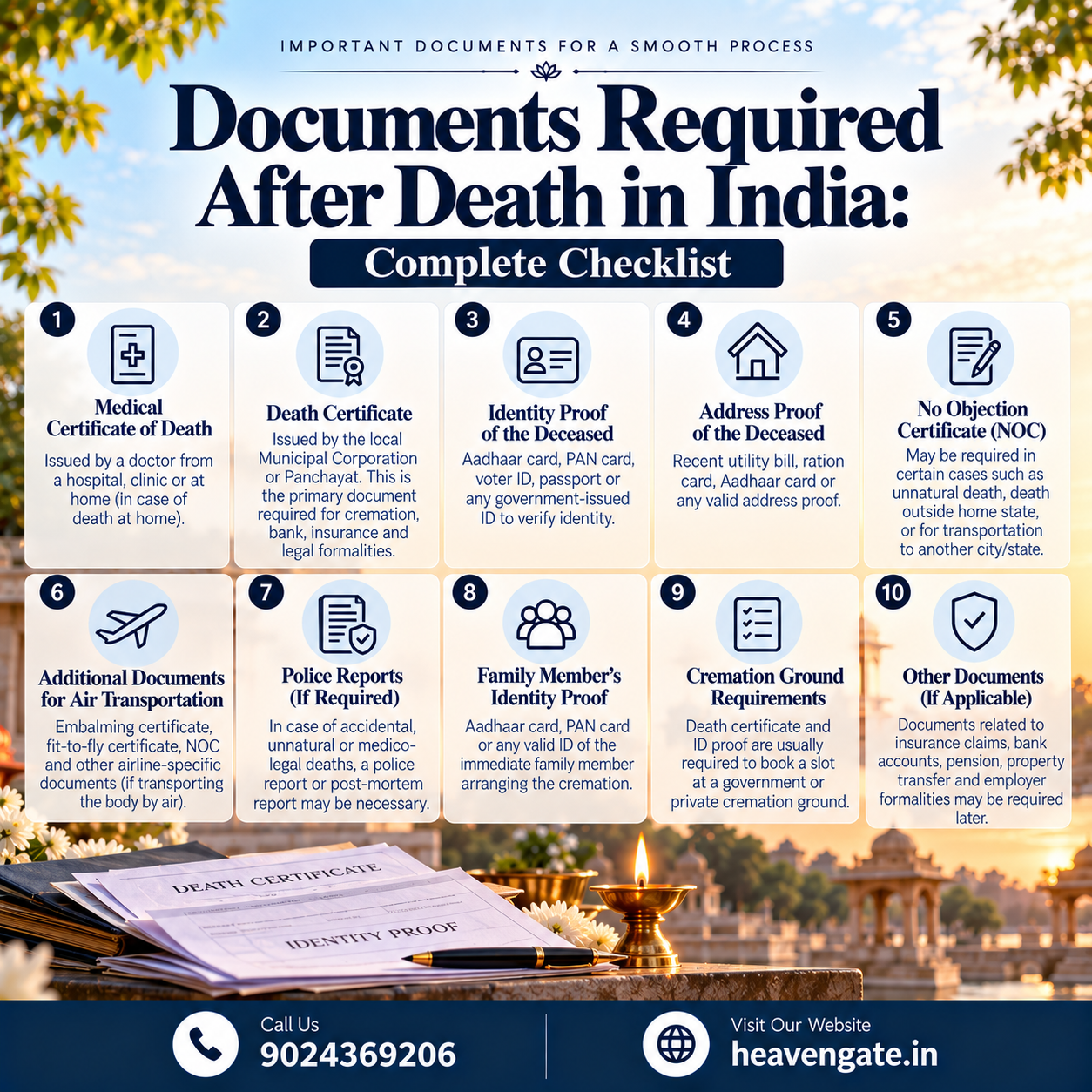
1. Essential Documents Required After Death in India

Start by gathering the following documents. Keep the originals safe and prepare photocopies or digital scans where possible.

  • Medical Certificate of Cause of Death: A medical professional or authorised institution issues the appropriate certificate or reporting form, depending on the circumstances.

  • Identity proof of the deceased: Keep available documents such as Aadhaar, passport, voter ID, PAN card, or another accepted identity document.

  • Identity proof of the applicant: The family member or person reporting the death may need their own ID.

  • Hospital records: Collect discharge summaries, medical records, and the hospital’s death-related documents if the death occurred in a hospital.

  • Death registration application or reporting form: The relevant registrar may require a prescribed form, depending on the location and circumstances.

  • Police documents, if applicable: Keep the FIR, post-mortem report, or police clearance when authorities handle an accidental, suspicious, or otherwise reportable death.

  • Cremation or burial receipt: Keep the receipt or other proof of the final rites if the local registration process requires it.

Important: Requirements can vary by state, municipality, and case type. Check the current instructions from the local registrar before submitting your application. The Government of India’s Civil Registration System provides information about official death registration services.

2. Documents Required When Death Occurs in a Hospital

When someone passes away in a hospital, ask the hospital staff to explain the release and registration process. They can clarify which documents they will issue and which steps the family must complete.

Keep these papers together:

  • Hospital-issued death-related medical documentation.

  • Medical Certificate of Cause of Death or the applicable prescribed form.

  • Hospital discharge summary or relevant medical records, where available.

  • Identity proof of the deceased.

  • Identity proof of the family member or informant.

  • Hospital release or mortuary release documents, if applicable.

  • Any additional authorisation required for collecting the body.

In many institutional cases, the hospital handles death reporting or guides the family through registration. However, confirm that the death has been reported correctly and ask how to obtain the official death certificate.

3. Documents Required When Death Occurs at Home

A death at home may require different steps, depending on whether a doctor attended the person and whether the circumstances are expected or unexplained.

If the death was expected

Contact the treating doctor or the appropriate medical authority to confirm the death and ask which medical document they can issue. Then contact the local registrar or municipal authority about the registration process.

Prepare:

  • Medical documentation confirming the death and its cause, where applicable.

  • The deceased person’s identity proof.

  • The applicant’s identity proof.

  • Address details and other information requested by the registrar.

  • The prescribed death registration form or application.

If the death was sudden or suspicious

Contact emergency services or the police as appropriate. Do not move the body or disturb the scene if authorities need to investigate. Police and medical authorities will explain which documents they require before the body can be released.

4. Documents Required to Obtain a Death Certificate

The death certificate is an official record of the death. Families often need it for legal, financial, insurance, pension, and other administrative matters.

Depending on the state and circumstances, the application may require:

  • Prescribed death registration form.

  • Medical Certificate of Cause of Death or other accepted proof of death.

  • Identity details of the deceased.

  • Identity proof of the informant or applicant.

  • Residential or address details, where requested.

  • Hospital, police, cremation-ground, or burial-ground records, where applicable.

  • Additional declarations or supporting documents for delayed registration or missing records.

The official Government Services Portal lists death registration as a mandatory process in India and directs applicants to the relevant registration system.

Where can families apply in Jaipur?

For a death in Jaipur, check the applicable Rajasthan death registration service or the relevant municipal authority. The Government Services Portal lists services for obtaining a death certificate in Jaipur and registering deaths in Rajasthan.


Tip: Check spellings, dates, and personal details carefully before submitting forms. Incorrect details can create problems when the family later uses the certificate for official work.

5. Documents Required for Cremation or Funeral Arrangements

The documents needed for cremation may vary by cremation ground, local authority, and circumstances of death. Contact the chosen facility before travelling.

Keep these documents ready where applicable:

  • Medical documentation confirming the death.

  • Identity details of the deceased.

  • Identity proof of the family member arranging the final rites.

  • Hospital or mortuary release documents, if required.

  • Police clearance or other authorisation for cases under investigation.

  • Cremation-ground booking or registration details, if applicable.

dead body transportation by air in India

6. Documents Required for Dead Body Transportation

Families sometimes need to transport the deceased from a hospital to a residence, cremation ground, or another city. The paperwork depends on the route and the authorities involved.

Before arranging transportation, check whether you need:

  • Medical documentation confirming the death.

  • Hospital or mortuary release papers.

  • Identity details of the deceased.

  • Police clearance, if applicable.

  • Destination and receiving-person details for intercity transportation.

  • Any permits or additional documents required by the relevant authorities.

For guidance, read Heaven Gate’s related guides on dead body transportation in Jaipur and dead body transportation by road.

If the family needs a freezer box while arranging the final rites, ask the service provider about availability, delivery, and any information required for booking.

7. Documents for Accidental or Unnatural Death

Accidents, suspected suicide, and other unnatural or unexplained deaths may require police and medical procedures before authorities release the body.

Depending on the case, authorities may request:

  • FIR or police report.

  • Post-mortem report.

  • Police clearance or body-release authorisation.

  • Hospital or emergency medical records.

  • Identity proof of the deceased.

  • Documents requested by the investigating officer or local registrar.

Do not assume that the regular hospital-death process applies to these cases. Follow the instructions of the police and authorised medical personnel before making cremation or transportation arrangements.

8. Documents for Deaths Outside India

When a person dies abroad and the family plans to bring the remains to India, the process involves foreign authorities and the relevant Indian embassy or consulate.

Depending on the country and circumstances, the family may need:

  • Local death certificate.

  • Hospital or medical report.

  • Passport or other identity documents of the deceased.

  • Embalming certificate, where required.

  • Embassy or consular authorisation.

  • Local police clearance, if applicable.

  • Transport, packaging, or health documents required by the authorities and airline.

Requirements differ by country and route. Therefore, contact the relevant Indian embassy or consulate and the receiving authorities before booking transportation.

For help with the process, visit Heaven Gate’s international repatriation service page.

9. Documents to Keep Safe After Receiving the Death Certificate

After the authorities issue the death certificate, store it securely and keep both physical and digital copies. You may need it for several later formalities.

Keep a separate folder for:

  • Official death certificate.

  • Medical records and cause-of-death documentation.

  • Cremation or burial receipt.

  • Insurance policy details and claim forms.

  • Bank account and pension records.

  • Property and vehicle documents.

  • Will, nomination details, or succession-related paperwork, where applicable.

  • Employer or retirement-benefit records, if relevant.

Different institutions have different requirements. Ask each bank, insurer, government office, or other organisation for its current document checklist before applying.

10. Quick Checklist: Documents Required After Death in India

Use this checklist to organise the paperwork without missing important items.

Your document checklist

0 of 9

 
Reset checklist

This list is a practical starting point, not a universal legal checklist. Only collect or submit the additional documents that apply to the circumstances and local rules.

Internal Linking Suggestions

Service Pages

Related Blog Posts

Frequently Asked Questions (FAQs)

1. What documents are required after death in India?

Common documents include medical documentation confirming the death, identity proof of the deceased, the applicant’s ID, and the prescribed death registration form. Police, hospital, or cremation records may also be necessary depending on the case.

2. Is a death certificate mandatory in India?

Death registration is mandatory in India. The registrar issues the official death certificate after the relevant registration process. Families should follow the applicable state and local requirements.

National Government Services Portal

3. Can a family arrange cremation without a death certificate?

The process depends on the local cremation ground and the circumstances of death. Medical confirmation and other authorisations may be required before the final rites. Contact the relevant authorities to confirm which documents they accept.

4. What documents are required for a death certificate in Jaipur?

Requirements may include the prescribed application, medical documentation, identity details, and supporting records. Additional documents may apply to home deaths, delayed registration, or cases involving the police. Check the current Rajasthan or Jaipur registration instructions.

5. Who issues the Medical Certificate of Cause of Death?

An authorised medical professional or institution issues the appropriate medical documentation according to the circumstances and applicable rules. This document supports the registration process; it is not necessarily the same as the final death certificate.

6. What happens if the family does not have the deceased person’s Aadhaar card?

Contact the local registrar to confirm the accepted alternatives and declaration requirements. Do not assume that one missing identity document automatically prevents registration.

7. Are police documents necessary after every death?

No. Police documents generally apply when the circumstances require police involvement, such as an accident, suspected unnatural death, or an investigation. Follow the instructions of the relevant authorities.

8. What documents are required to transport a deceased person from Jaipur to another city?

The family may need medical documentation, body-release papers, identity details, and police clearance where applicable. Additional requirements can depend on the route and the authorities involved.

9. Can someone apply for a death certificate after a delay?

Yes, but delayed registration may involve additional procedures, declarations, permissions, or fees. Contact the relevant registrar to confirm the current requirements for the length of the delay.

10. Can Heaven Gate help with funeral arrangements in Jaipur?

Heaven Gate assists families with funeral-related services, including cremation arrangements, dead body transportation, hearse van services, and freezer box services. Contact the team to discuss the support required for your situation.