

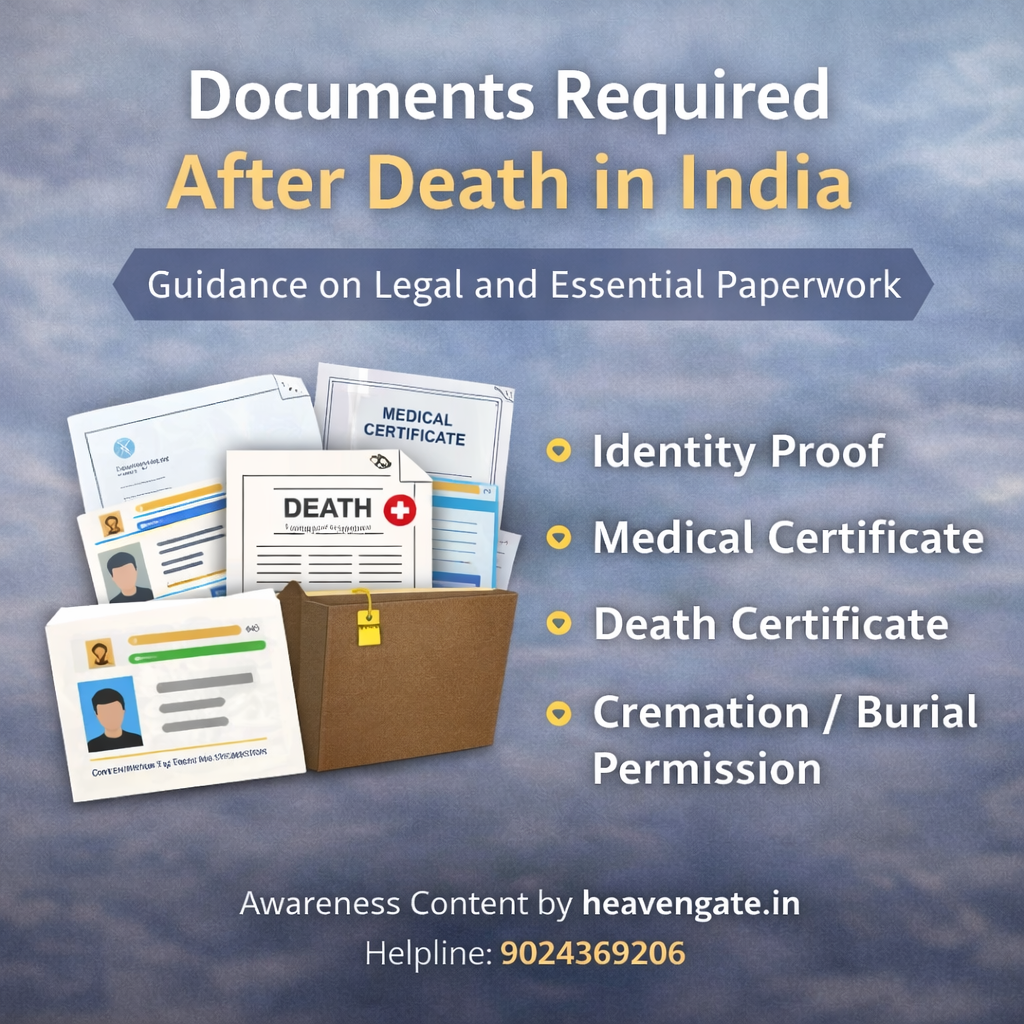

Documents Required After Death in India
After the death of a loved one, families must complete several legal and administrative formalities. However, many people remain unaware of the exact documents required after death in India. This awareness guide explains each document clearly to help families avoid confusion and delays.
Why Documents Are Important After Death
Legal documents help confirm the death officially. Moreover, they allow families to proceed with cremation, burial, insurance claims, and property matters. Therefore, collecting the correct paperwork becomes essential.
Medical Certificate of Death
The medical certificate is the first and most important document.
Who Issues the Medical Certificate?
A registered doctor or hospital issues this certificate. First, the doctor confirms the cause of death. Then, they provide written confirmation.
This certificate is mandatory for further procedures.
Death Certificate
The death certificate is an official government record.
Where to Obtain the Death Certificate
Municipal corporations or local authorities issue the death certificate. Usually, families apply within a few days of death. Moreover, multiple copies help with future requirements.
Identity Proof of the Deceased
Identity proof confirms personal details.
Commonly Accepted ID Proofs
Aadhaar card
PAN card
Passport
Voter ID
These documents help verify records across departments.
Cremation or Burial Permission
Local authorities require permission for last rites.
Why This Permission Is Needed
Cremation or burial permission ensures lawful disposal of the body. Therefore, authorities issue this document before final rites.
Identity Proof of Family Members
Family identification is also necessary.
Purpose of Family ID Proof
Authorities use family ID proof to confirm relationships. Moreover, it helps during insurance and bank processes.
Insurance Policy Documents
Insurance papers help claim financial benefits.
Types of Insurance Documents
Life insurance policy
Health insurance records
Employer insurance papers
However, families must submit these with the death certificate.
Bank and Financial Documents
Financial records require proper documentation.
Common Bank Documents
Bank passbooks
Fixed deposit receipts
Loan documents
Therefore, banks release funds only after verification.
Property and Asset Documents
Property transfer requires legal proof.
Important Property Papers
Property ownership documents
Will or succession certificate
Mutation papers
These documents prevent disputes later.
Will or Succession Certificate
A will defines asset distribution.
If a Will Is Not Available
In such cases, families apply for a succession certificate. Consequently, legal authorities decide asset distribution.
Documents Required for Death Outside Home
Some situations require additional paperwork.
Special Cases
Police clearance for accidental death
Post-mortem report
FIR copy, if applicable
These documents support legal compliance.
Tips to Manage Documents Smoothly
Handling paperwork during grief feels overwhelming. However, a structured approach helps.
Practical Tips
Keep multiple photocopies
Store documents in one folder
Seek professional guidance if needed
As a result, families save time and effort.
Final Thoughts
Understanding the documents required after death in India helps families manage legal responsibilities with confidence. Although the process feels difficult, proper awareness reduces stress and delays. Preparation and timely action ensure a smoother journey during an emotionally challenging time.
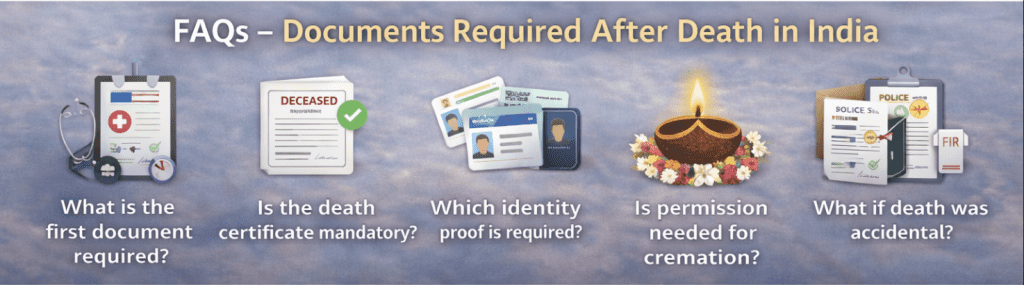
❓ FAQs – Documents Required After Death in India
1. What is the first document required after death in India?
The medical certificate of death issued by a registered doctor or hospital is the first required document.
2. Is a death certificate mandatory after death in India?
Yes, a government-issued death certificate is mandatory for cremation, burial, insurance claims, and legal procedures.
3. How many copies of the death certificate are needed?
Families should obtain multiple certified copies, as banks, insurers, and authorities often require separate submissions.
4. Which identity proof of the deceased is required after death?
Commonly required identity proofs include Aadhaar card, PAN card, passport, or voter ID of the deceased.
5. Are documents required for cremation or burial in India?
Yes, cremation or burial permission from local authorities is usually required along with the death certificate.
6. What documents are needed for insurance or bank claims after death?
Insurance policies, bank account details, nominee information, and the death certificate are required for claims.
7. What additional documents are required if death was accidental or unnatural?
In such cases, police clearance, post-mortem report, and FIR copy may be required before further procedures.
Hospital Death vs Home Death – Legal Process in India
January 28, 2026[…] Read More […]
Funeral Services in Jaipur Explained – Complete Guide
February 14, 2026[…] List Of Document Required […]
Funeral Services in Mumbai – 24/7 Cremation & Last Rites Support
February 15, 2026[…] List Of Document Required […]