

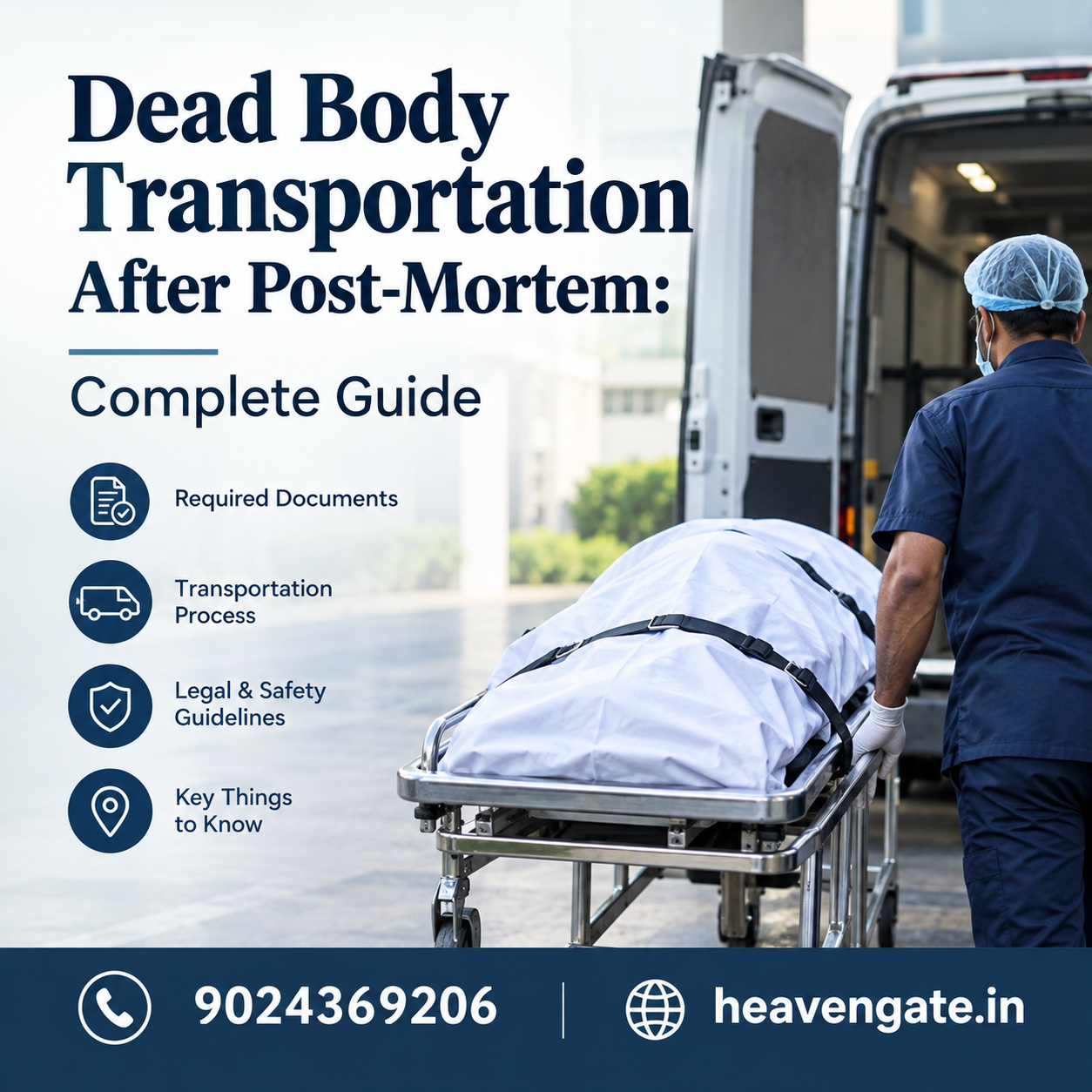

Losing a loved one is difficult. The situation can become even more stressful when a post-mortem takes place before transportation.
Many families ask what happens next. They also want to know which documents they need and how they can move the deceased to another city.
This complete guide explains dead body transportation after post-mortem, including the legal process, required documents, road and air transportation, and important steps for families in India.
What Is a Post-Mortem?
A post-mortem is a medical examination conducted to determine the cause of death. It is usually performed when required by law or ordered by the appropriate authorities.
Common situations include:
Road accidents
Unnatural deaths
Suspicious deaths
Sudden unexplained deaths
Cases under police investigation
Once the post-mortem is completed and the authorities release the body, families can begin transportation arrangements.
Can a Dead Body Be Transported After a Post-Mortem?
Yes. A deceased person can be transported after a post-mortem once the required legal and medical formalities are complete.
Before transportation, families should collect all necessary documents and confirm whether road or air transportation is suitable for the destination.
A professional dead body transportation service can also help coordinate the process.
Documents Required After a Post-Mortem
Proper documentation helps avoid delays during transportation.
Depending on the case, families may need:
Death certificate
Post-mortem report or release documents
Police NOC or clearance, when required
Hospital release documents
Identification proof
Embalming certificate, when applicable
Coffin or sealing certificate for air travel
Airline cargo documents for air transportation
Requirements may differ between states and airlines. Therefore, always verify the latest documentation before travel.
Step-by-Step Process After a Post-Mortem
Families often feel overwhelmed after the examination. The transportation process becomes easier when completed step by step.
Step 1: Body Release From Hospital
The hospital releases the deceased after completing the required formalities.
Families should verify the identity and collect the release documents before leaving.
Step 2: Collect Legal Documents
Next, collect the death certificate, post-mortem documents, and any police clearance required for the case.
Keeping multiple copies can be helpful during transportation.
Step 3: Decide the Transport Method
Choose the most suitable option based on distance and urgency.
Road transportation: Suitable for many domestic routes.
Air transportation: Often preferred for long-distance travel across India.
Step 4: Arrange Embalming if Needed
Air transportation may require embalming depending on airline and destination requirements.
An authorized professional performs the procedure and issues the embalming certificate.
Step 5: Begin Transportation
Once documents are ready, the deceased can travel to the destination by road or air.
Dead Body Transportation by Road After Post-Mortem
Road transportation is a common choice for domestic travel.
It offers direct movement between cities without airport cargo procedures.
Popular routes include:
Jaipur to Delhi
Delhi to Jaipur
Hyderabad to Bangalore
Bangalore to Chennai
Jaipur to Ahmedabad
For families looking for dead body transportation in Jaipur, road ambulances can provide safe long-distance transportation across Rajasthan and nearby states.
Dead Body Air Transportation After Post-Mortem
Air transportation becomes useful for longer routes.
However, airlines require additional coordination before accepting human remains.
The process may include:
Embalming
Coffin preparation
Documentation verification
Airport cargo booking
Airline approval
Destination ambulance
For example, families arranging dead body air transportation from Jaipur to Mumbai may require airport coordination in addition to ambulance services.

Is Embalming Required After a Post-Mortem?
Not every case requires embalming.
The requirement depends on:
Airline policy
Destination
Transportation method
Time between death and transportation
Applicable regulations
For road transportation, embalming may not always be necessary. Air transportation often involves additional preparation requirements.
Families should confirm the latest requirements before making arrangements.
Is Police NOC Required After a Post-Mortem?
A Police NOC is not automatically required after every post-mortem.
It may apply in cases involving:
Accidental death
Unnatural death
Police investigation
Court or legal procedures
The concerned police department or investigating authority can confirm whether an NOC is necessary.
Dead Body Transportation in Jaipur After Post-Mortem
Families in Jaipur may need transportation from:
SMS Hospital
Private hospitals
Mortuaries
Medical colleges
Nursing facilities
A professional dead body transportation service in Jaipur can help with pickup, ambulance arrangements, documentation guidance, and transportation to another city or airport.
Families can also explore dead body transportation services for complete assistance.
Dead Body Transportation to Other Indian Cities
After a post-mortem, families may need to move the deceased across India.
Common destinations include:
Route | Transport Option |
|---|---|
Jaipur to Delhi | Road / Air |
Jaipur to Mumbai | Road / Air |
Delhi to Kolkata | Road / Air |
Hyderabad to Bangalore | Road |
Bangalore to Chennai | Road |
Jaipur to Ahmedabad | Road |
The most suitable option depends on distance, time, documents, and family preference.
Common Mistakes to Avoid
A few simple precautions can prevent unnecessary delays.
Do Not Leave Without Documents
Always collect hospital release papers before arranging transportation.
Confirm Airline Requirements
Every airline may have different procedures for human remains.
Verify Police Clearance
Ask whether the case requires police permission before travel.
Check Destination Details
Confirm the receiving address and ambulance arrangements in advance.
Request an Itemized Quotation
Ask for separate charges for ambulance, embalming, coffin, airport handling, and cargo.
Why Choose a Professional Transportation Service?
Managing transportation after a post-mortem involves several responsibilities.
A professional service can help coordinate:
Hospital pickup
Ambulance transportation
Documentation guidance
Embalming coordination
Coffin preparation
Airport handling
Air cargo
Destination ambulance
This allows families to focus on supporting one another during a difficult time.
Internal Linking Suggestions
Service Pages
Related Blog Posts
Frequently Asked Questions
Can a dead body be transported immediately after a post-mortem?
Transportation can begin after the hospital and authorities complete the required formalities and release the body.
What documents are required after a post-mortem?
Common documents include the death certificate, post-mortem release documents, identification proof, and additional transportation documents depending on the route.
Is embalming compulsory after a post-mortem?
No. The requirement depends on the transport method, airline, destination, and applicable regulations.
Is a Police NOC required after a post-mortem?
Not in every case. It may apply when the death involves an accident, investigation, or other legal procedures.
Can a dead body travel by air after a post-mortem?
Yes. Families can arrange air transportation after completing the required documentation, embalming, coffin preparation, and airline procedures.
Can I arrange dead body transportation from Jaipur after a post-mortem?
Yes. Professional transportation services can assist with pickup, ambulance arrangements, documentation guidance, and transportation to other Indian cities.
How long does the transportation process take?
The timeline depends on documentation, distance, transport method, and airline or road arrangements.