

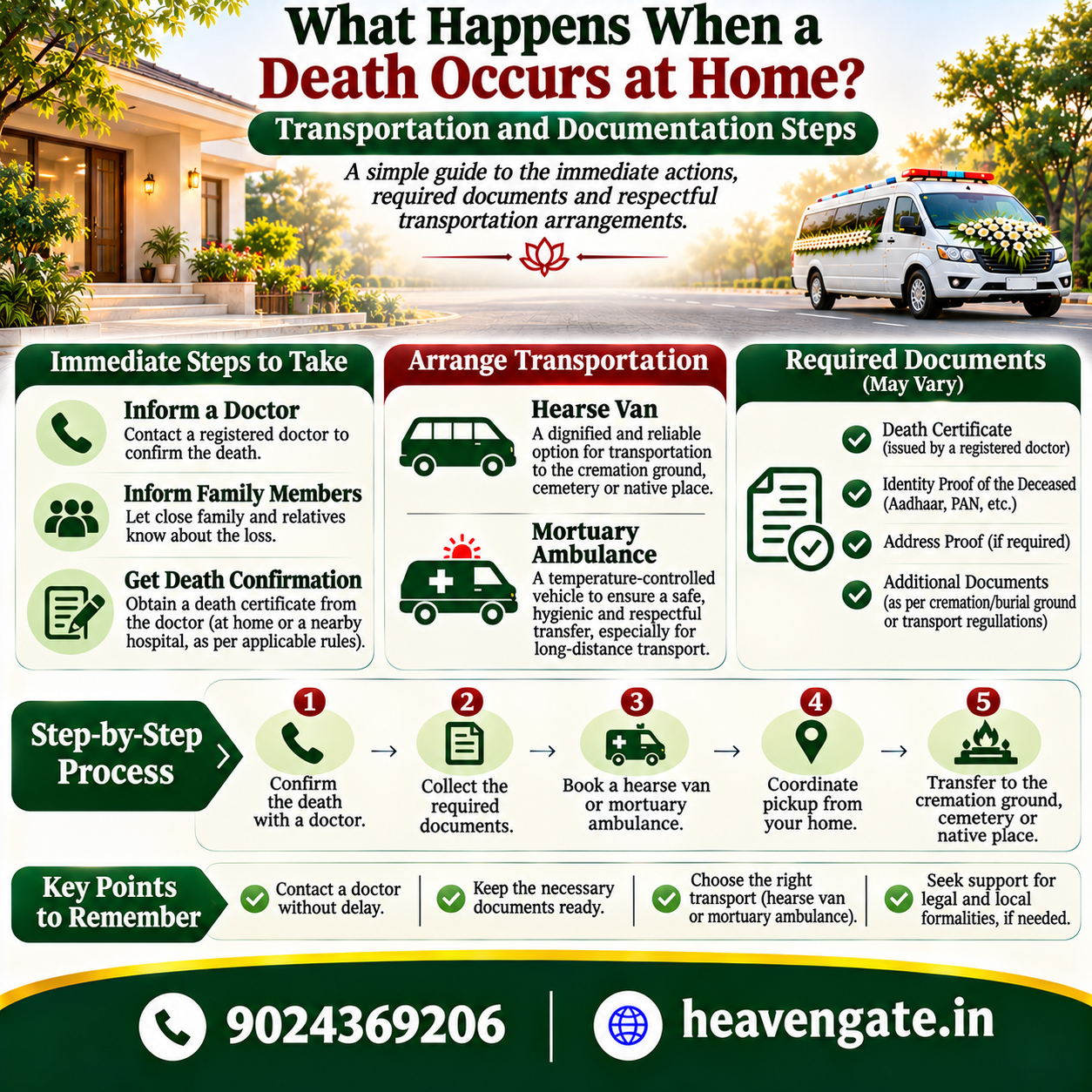

When a loved one passes away at home, families often face confusion and emotional stress. They may not know whom to contact, which documents to arrange, or how to transport the deceased safely.
However, following the correct steps can make the process more organised. Families should first arrange medical confirmation of death. Next, they should understand the documentation requirements and coordinate suitable funeral transportation.
This guide explains what happens when a death occurs at home in India. It also covers the role of a doctor, local authorities, mortuary vans, hearse vans, and funeral service providers.
1. What Should You Do Immediately After a Death at Home?
First, remain calm and contact a qualified medical professional. A doctor must establish the death and guide the family on the next steps.
If the death appears unexpected, suspicious, accidental, or unexplained, contact the police or emergency authorities. Do not move the body until the relevant authorities provide instructions.
For an expected death due to an existing illness, the family should contact the treating doctor. The doctor can review the medical history and explain the applicable procedure.
Here are the first steps families should follow:
Contact the treating doctor or an authorised medical professional.
Follow medical instructions for confirmation of death.
Contact the police if the circumstances require legal investigation.
Keep the deceased person’s identity documents and medical records ready.
Inform close family members.
Contact a funeral service provider once the required permissions are clear.
Most importantly, do not arrange transportation before completing the necessary medical and legal formalities.
2. How Is Death Confirmed at Home?
A doctor or other legally authorised medical professional must confirm death according to applicable rules.
The process may differ depending on the circumstances.
Expected Death at Home
An expected death may occur when a person receives treatment for a known illness or has a documented medical history.
In such cases, the family should contact the treating doctor. The doctor can assess the situation and explain whether they can issue the required medical certificate or whether another authority must complete the process.
Sudden or Unexplained Death at Home
A sudden death without a clear medical explanation may require police involvement and further examination.
For example, authorities may need to investigate an accident, injury, suspected unnatural death, or other unusual circumstances.
Therefore, families should avoid disturbing the scene or moving the deceased until the police or competent authority gives permission.
3. Which Documents Are Required After a Death at Home?
Documentation plays an important role in funeral arrangements and transportation. However, the exact requirements depend on the circumstances of death, local procedures, and the destination.
Families should keep the following documents ready where applicable:
A. Medical Certificate or Death Confirmation
A medical professional may issue documentation confirming the death. The exact document depends on the circumstances and the applicable registration process.
B. Identity Proof of the Deceased
Keep an identity document available, such as:
Aadhaar card
Passport
Voter ID
Driving licence
Other accepted identity proof
C. Identity Proof of the Family Member
The person coordinating transportation or funeral arrangements may need to provide their own identity proof.
D. Medical Records
If the deceased received treatment before passing away, keep relevant prescriptions, hospital records, discharge summaries, and medical reports.
These records may help the doctor or authorities understand the circumstances.
E. Police or Post-Mortem Documents
Authorities may require an inquest, post-mortem examination, or other legal formalities in certain cases.
If the death falls under a medico-legal investigation, the family must follow the instructions of the police and competent authorities.
F. Death Registration Documents
The family must register the death with the appropriate local authority under the applicable registration procedure.
The authority may request medical confirmation and supporting documents. Families should check the exact requirements with their local municipal office or designated registrar.
4. How Does Death Registration Work in India?
After the required medical and legal formalities, the family must arrange official death registration.
The local Registrar of Births and Deaths or the designated registration authority handles this process.
The family should:
Identify the correct local registration authority.
Ask which documents they require.
Submit the prescribed registration form and supporting records.
Follow up on the application.
Obtain the official death certificate after registration.
The death certificate serves as an important official record. Families may need it for insurance claims, bank matters, pension-related work, property matters, and other legal or administrative requirements.
However, the process and document requirements may vary by state and local authority.
5. How Can You Arrange Dead Body Transportation After a Death at Home?
Once the doctor or competent authority completes the required formalities and permits movement, the family can arrange suitable transportation.
The right vehicle depends on the distance, condition of the deceased, destination, and type of funeral arrangement.
Mortuary Van Service
A mortuary van helps transport the deceased from a residence to a hospital, mortuary, cremation facility, or another permitted destination.
Families may need this service when they require a dedicated vehicle for local or longer-distance transportation.

6. What Happens When the Family Needs Transportation to Another City?
Sometimes, the family wishes to take the deceased to their hometown for the final rites.
For example, a death may occur at home in Jaipur while the family wishes to complete the funeral in Delhi, Ahmedabad, Mumbai, or another city.
In such cases, the family should arrange transportation after completing all required permissions and documentation.
The process generally includes:
Confirming the destination and preferred travel arrangements.
Selecting a suitable mortuary vehicle.
Discussing preservation requirements.
Checking the documents required for the journey.
Confirming the pickup location and receiving arrangements.
Coordinating the arrival with relatives or the funeral venue.
The family should also confirm the expected journey plan with the transportation provider. Travel time can change due to traffic, road conditions, weather, and the exact destination.
For additional guidance, read:
Dead Body Transportation by Road: Cost, Documents and Process
How to Transport a Dead Body from One City to Another in India
7. What If the Death Occurs in Jaipur or Another Major City?
Families in different cities may need local funeral transportation and documentation support.
The basic process remains similar. However, local registration rules, service availability, and authority procedures may differ.
Here are some examples of city-specific services:
Jaipur
Families can enquire about funeral services in India and suitable transportation arrangements for a home-to-cremation transfer in Jaipur.
Delhi
For families arranging transportation or funeral coordination in Delhi, relevant options include dead body transportation in Delhi and funeral services in Delhi.
Pune
Families in Pune can explore dead body transportation in Pune and hearse van services in Pune.
Indore
Families in Indore can enquire about dead body transportation in Indore and freezer box arrangements.
Hyderabad
For local transportation requirements, families can explore dead body transportation in Hyderabad and hearse van services in Hyderabad.
Always confirm the service area, vehicle availability, documentation requirements, and estimated charges before booking.
8. What If the Death Requires Police or Post-Mortem Formalities?
Not every death at home follows the same procedure.
When a death appears unnatural, suspicious, accidental, or unexplained, the authorities may need to investigate the circumstances.
In such cases:
Contact the police or relevant emergency authority.
Follow their instructions.
Do not move or disturb the deceased unless an authorised person permits it.
Allow the required examination or post-mortem process.
Obtain the necessary release or movement permission before arranging transportation.
A private funeral or transportation provider cannot independently release a body under legal investigation. The family must wait for approval from the competent authority.
This step protects the legal process and helps prevent avoidable complications.
9. How Much Does Dead Body Transportation Cost After a Home Death?
The cost depends on the type of vehicle, travel distance, location, waiting time, and additional arrangements.
For example, a local transfer from a residence to a nearby cremation ground may require a different arrangement from an intercity journey.
The final charges may depend on:
Pickup and drop locations
Total travel distance
Type of mortuary or hearse vehicle
Waiting time
Preservation requirements
Additional handling or coordination services
Availability at the required time
Therefore, families should request a clear quotation before confirming the service.
For more information, read Dead Body Transportation Charges Per KM in India.
10. Common Mistakes Families Should Avoid
During an emotional situation, families may overlook important steps. However, avoiding these mistakes can make the process smoother.
1. Moving the deceased before required permission
Always follow medical and legal instructions before arranging transportation.
2. Ignoring medical confirmation
Contact the appropriate medical professional to establish the death and understand the next steps.
3. Leaving documentation until the last moment
Keep identity documents and available medical records ready.
4. Booking the wrong vehicle
A mortuary van and a hearse van serve different transportation needs. Explain the pickup and destination clearly.
5. Assuming every case follows the same procedure
Expected natural deaths and medico-legal cases may involve different formalities.
6. Not confirming the quotation
Ask about vehicle charges, waiting time, distance, and additional services before booking.
11. How Heaven Gate Funeral Care Can Help
Managing funeral arrangements after a death at home can feel overwhelming. Families may need help coordinating transportation, preservation arrangements, and final-journey services.
Heaven Gate Funeral Care assists families with funeral-related transportation and coordination requirements, subject to service availability and applicable permissions.
Depending on the location and family requirements, support may include:
Mortuary van arrangements
Hearse van services
Dead body transportation
Freezer box arrangements
Funeral and cremation coordination
Guidance on transportation planning
Assistance with related funeral arrangements
Families can discuss their requirements and confirm the documents, permissions, availability, and charges before booking.
Internal Link Suggestions
Service Pages
Related Blog Posts
Frequently Asked Questions (FAQs)
1. What should I do first when someone dies at home?
Contact the treating doctor or an authorised medical professional. If the death is sudden, suspicious, accidental, or unexplained, contact the police or relevant authorities and follow their instructions.
2. Can we move the deceased immediately after death at home?
Not always. First, complete the required medical confirmation and legal formalities. In a medico-legal case, wait for permission from the competent authority before moving the deceased.
3. Which documents are required after a death at home?
Requirements vary. Commonly needed documents may include medical confirmation, identity proof of the deceased, the family representative’s identity proof, and relevant medical records. Police or post-mortem documents may apply in certain cases.
4. Who issues a death certificate in India?
The designated Registrar of Births and Deaths or local registration authority issues the official death certificate after completing the registration process.
5. Is a doctor’s certificate necessary for a home death?
Medical confirmation is an important part of the process. The exact document and issuing professional depend on the circumstances and applicable rules. Contact the treating doctor or local authority for guidance.
6. Which vehicle is suitable for transporting a deceased person from home?
A mortuary van generally supports transportation from a residence to a mortuary, hospital, or another permitted location. A hearse van generally supports the final journey to a cremation ground or burial location.
7. Can a deceased person be transported from Jaipur to another city?
Yes, families can arrange intercity transportation after completing the required formalities and permissions. The vehicle and preservation arrangements depend on the journey and applicable requirements.
8. Is a freezer box necessary when death occurs at home?
Not in every case. A freezer box may help when the funeral needs to be delayed. Families should discuss preservation requirements with a suitable service provider.
9. What happens if the death at home is a medico-legal case?
The police or competent authority may conduct an investigation and arrange an inquest or post-mortem examination. The family must follow their instructions and obtain the required release permission before transportation.
10. How can I book a mortuary van or hearse van after a home death?
Contact a funeral transportation provider with the pickup location, destination, required vehicle, and available documentation details. Confirm availability, charges, and any required permissions before booking.