

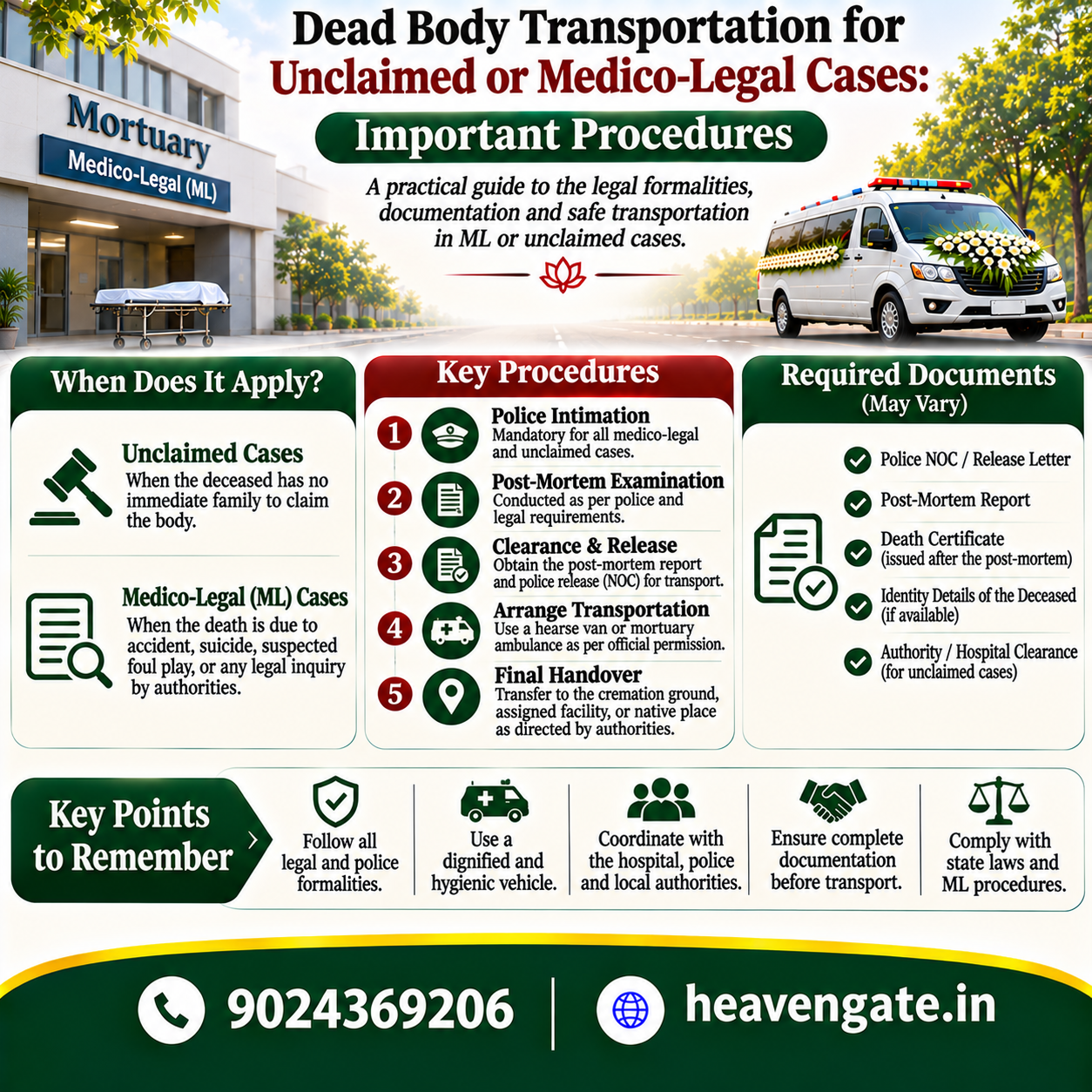

Dead body transportation requires careful coordination, especially when a case involves an unclaimed body or medico-legal investigation. In such situations, families, hospitals, police authorities, and funeral service providers may need to coordinate several formalities before transportation can begin.
Unlike routine funeral transportation, these cases may involve legal procedures, identification checks, post-mortem examinations, and official release permissions.
Therefore, families and service providers must understand their responsibilities before arranging a mortuary van or hearse van.
This guide explains the important procedures for dead body transportation in unclaimed or medico-legal cases. It also covers documentation, police clearance, hospital coordination, and funeral arrangements.
1. Understanding Unclaimed and Medico-Legal Cases
Before arranging transportation, it is important to understand the difference between an unclaimed body and a medico-legal case.
What Is an Unclaimed Dead Body?
An unclaimed dead body refers to a deceased person whose identity or family details remain unknown, or whose relatives have not come forward to claim the body.
Such cases may arise when:
A person dies without identification documents.
Authorities cannot locate the family.
No relative comes forward to claim the deceased.
The deceased has no immediately available family contact.
Authorities cannot establish the person’s identity.
The relevant authorities handle identification, documentation, custody, and final arrangements according to applicable procedures.
What Is a Medico-Legal Case?
A medico-legal case involves circumstances that require legal or police examination.
Examples may include:
Accidental deaths.
Suspected unnatural deaths.
Deaths involving possible criminal activity.
Deaths under suspicious circumstances.
Cases that require a post-mortem examination.
Other deaths that authorities classify as medico-legal.
In these situations, the police and relevant medical authorities may need to complete their procedures before releasing the deceased.
Important: An unclaimed body and a medico-legal case are not necessarily the same. A person may have known relatives but still be involved in a medico-legal investigation.
2. Who Handles Unclaimed or Medico-Legal Dead Bodies?
The responsible authority depends on the circumstances and location of the death.
Several organisations may take part in the process.
Police Authorities
Police authorities may handle identification, investigation, inquest procedures, and coordination with the hospital.
They may also guide the family or relevant agency about the required permissions.
Government or Private Hospitals
Hospitals may maintain custody of the deceased until they complete the required medical and administrative procedures.
In medico-legal cases, the hospital may coordinate with police authorities and authorised forensic departments.
Forensic or Post-Mortem Departments
When authorities require a post-mortem examination, the designated medical department conducts the procedure.
The deceased may remain under authorised custody until the examination and related formalities finish.
Municipal or Local Authorities
Depending on local rules, municipal bodies or other designated agencies may coordinate arrangements for unclaimed bodies.
They may handle documentation, authorised funeral arrangements, and related responsibilities.
Funeral Transportation Providers
A funeral transportation provider may arrange a suitable mortuary vehicle after the competent authority approves the transfer.
However, a private service provider cannot independently release an unclaimed body or override a legal restriction.
3. Important Procedures Before Transporting a Medico-Legal Body
Families and service providers must follow the applicable legal process before moving a deceased person involved in a medico-legal case.
The following steps provide a general overview.
Step 1: Inform the Police or Relevant Authority
When the circumstances require police involvement, the hospital or reporting person must follow the applicable procedure.
The police may record details, examine the circumstances, and guide the next steps.
Step 2: Complete Identification Formalities
Authorities may need to establish the identity of the deceased.
They may use available identity documents, family statements, records, or other authorised identification procedures.
If the identity remains unknown, authorities follow the applicable unclaimed-body identification process.
Step 3: Complete the Inquest or Investigation
Depending on the case, the police may conduct an inquest or other investigation.
The family should cooperate with the authorities and provide the information they request.
Step 4: Complete the Post-Mortem Examination, Where Required
A medico-legal case may require a post-mortem examination.
The designated medical authority conducts the examination according to applicable procedures.
The family or transportation provider should not arrange removal before the authorised department completes the required formalities.
Step 5: Obtain Official Release Permission
After the relevant procedures, the competent authority may issue or communicate the required release permission.
The family or authorised representative should confirm that the deceased can legally leave the hospital or mortuary.
Step 6: Arrange Suitable Transportation
Once the authority permits the transfer, the family or responsible agency can arrange a suitable mortuary vehicle.
Share the pickup location, destination, and required timing with the service provider.
Important: The exact procedure may vary by state, district, and case type. Always follow the instructions of the police, hospital, and competent authority.
4. Documents Required for Dead Body Transportation in Medico-Legal Cases
Documentation plays an important role in these cases.
However, no single document checklist applies to every situation. Requirements depend on the circumstances, investigating authority, and destination.
Commonly relevant documents may include:
1. Death-Related Medical Documentation
The hospital or authorised medical professional may provide relevant records confirming the death.
2. Police Documentation or Release Permission
The police may issue or approve documents related to the investigation, inquest, or release process.
The exact document depends on the case.
3. Post-Mortem Documentation, Where Applicable
If authorities require a post-mortem examination, the relevant department may provide documentation after completing its procedure.

5. How to Arrange Mortuary Van Service for a Medico-Legal Case
After the competent authority permits transportation, the family or authorised agency can contact a funeral transportation provider.
A suitable mortuary van can help move the deceased from a hospital, mortuary, or authorised facility to the approved destination.
Share the Pickup Details
Provide the complete hospital or mortuary address.
Also, mention the name of the authorised contact person who will coordinate the release.
Confirm Official Permission
Before confirming the pickup, ensure that the relevant authority has approved the transfer.
Share any required release information with the service provider.
Choose a Suitable Vehicle
Ask about the available mortuary vehicle and its suitability for the transfer.
The provider can explain the available arrangements based on the location and destination.
Confirm the Destination
The family or authorised agency should provide the complete destination address.
For unclaimed cases, the authority may specify the approved destination.
Confirm the Charges and Schedule
Ask for a clear quotation and confirm the vehicle availability.
Also, clarify any waiting time or additional service charges.
6. Transportation Arrangements for Unclaimed Dead Bodies
Unclaimed-body transportation requires special care because no relative may be available to coordinate the transfer.
The responsible authority generally manages identification, custody, release, and final arrangements.
When the Identity Remains Unknown
Authorities may follow identification procedures and maintain the relevant records.
The transportation provider should act only after receiving the required authorisation.
When No Family Member Comes Forward
The competent authority may coordinate the next steps under applicable local procedures.
Depending on the case, the municipality, hospital, police, or another designated agency may handle the arrangements.
When Authorities Approve Final Disposal
Once the authority approves transportation or final arrangements, it can coordinate with an authorised service provider.
The provider may then arrange a suitable vehicle for the approved destination.
Remember: Private funeral service providers cannot independently decide the disposal or release of an unclaimed body. They must follow the competent authority’s instructions.
7. Choosing Between a Mortuary Van and Hearse Van
Selecting the right vehicle is important when arranging dead body transportation.
However, the vehicle should match the purpose of the transfer.
Mortuary Van
A mortuary van is designed to transport the deceased between hospitals, mortuaries, residences, and other destinations.
Families or authorised agencies may enquire about this vehicle for approved local or long-distance transfers.
Hearse Van
A hearse van generally supports funeral-related transportation.
It may transport the deceased to a cremation ground, burial location, or another approved funeral destination.
Which Vehicle Should You Choose?
The choice depends on:
The approved pickup and destination.
The distance involved.
The purpose of transportation.
Vehicle availability.
Any specific instructions from the authorities.
For more information, read Difference Between Mortuary Van and Hearse Van.
8. Preservation and Handling Requirements
Preservation requirements depend on the condition of the deceased, the expected transfer time, and instructions from the authorised medical or administrative department.
Possible arrangements may include:
Suitable preparation by the hospital or mortuary.
Embalming, where required or advised.
A freezer box, where appropriate.
Secure placement inside the transportation vehicle.
Additional preparation based on the journey and applicable requirements.
However, families should not assume that every medico-legal case requires the same preservation method.
A freezer box does not automatically replace embalming. Similarly, the need for embalming depends on the circumstances and applicable instructions.
In medico-legal cases, preservation arrangements must not interfere with evidence collection, examination, or official procedures.
Therefore, always obtain approval from the responsible authority before arranging any preparation.
Read: Difference Between Mortuary Freezer Box and Embalming.
9. City-Wise Dead Body Transportation and Funeral Arrangements
Families and authorised agencies may need transportation services in different Indian cities.
The exact arrangements depend on local permissions, vehicle availability, and the approved destination.
For example, families can enquire about:
Dead body transportation in Jaipur.
Mortuary van service in Delhi.
Dead body transportation in Ahmedabad.
Hearse van service in Bengaluru.
Funeral transportation in Pune.
Dead body transportation in Hyderabad.
For available service information, explore these pages:
Always confirm service availability and the applicable legal requirements for the specific case.
10. Common Challenges in Unclaimed and Medico-Legal Transportation
These cases may involve additional procedures. Therefore, families and service providers should prepare for possible challenges.
Pending Police Clearance
Authorities may need to complete an investigation or inquest before releasing the deceased.
The family should follow their instructions and avoid arranging unauthorised removal.
Delayed Identification
In unclaimed cases, authorities may need additional time to establish identity.
The responsible department must complete the required identification process.
Post-Mortem Procedures
A post-mortem examination may delay transportation.
The family must wait until the authorised department completes the required procedures and approves release.
Missing Documents
Incomplete paperwork can create delays.
Therefore, ask the hospital or responsible authority for the exact document checklist.
Unclear Responsibility
Families may not know whether the hospital, police, or municipal authority handles the next step.
Ask the hospital administration to identify the responsible department and provide the relevant contact details.
11. How Heaven Gate Funeral Care Can Help
Heaven Gate Funeral Care supports families with funeral transportation and related arrangements.
Families who need dead body transportation can contact the team to enquire about suitable vehicle arrangements.
Depending on the circumstances, location, and service availability, assistance may include:
Mortuary van arrangements.
Hearse van services.
Local and long-distance dead body transportation.
Guidance on transportation documentation.
Coordination of preservation requirements.
Funeral and cremation-related assistance.
For unclaimed or medico-legal cases, the competent authority must approve the release and transportation before the service provider can proceed.
Internal Link Suggestions
Service Pages
Related Blog Posts
Frequently Asked Questions (FAQs)
1. What is an unclaimed dead body?
An unclaimed dead body refers to a deceased person whose identity or family details remain unknown, or whose relatives have not come forward to claim the body. The responsible authorities handle identification, custody, and final arrangements.
2. What is a medico-legal death case?
A medico-legal case involves circumstances that require police or legal examination. Examples may include accidental, unnatural, suspicious, or otherwise legally reportable deaths.
3. Can a mortuary van transport a body involved in a medico-legal case?
Yes, families or authorised agencies can arrange a suitable mortuary van after the competent authority approves the release and transfer. The provider must follow the official instructions.
4. Is police permission required before transporting a medico-legal dead body?
The required permission depends on the circumstances and applicable procedures. In cases involving police investigation or post-mortem examination, the family must follow the relevant authority’s release instructions.
5. Can a family collect a body before the post-mortem examination?
The family must follow the instructions of the police and authorised medical department. If authorities require a post-mortem examination, transportation cannot proceed until they complete the applicable procedure and approve release.
6. What documents are required for unclaimed dead body transportation?
The responsible authority determines the documents. These may include death-related records, police documentation, post-mortem records, release permission, and authorisation for the approved transfer.
7. Who is responsible for arranging transportation of an unclaimed body?
The responsible authority depends on local procedures and the circumstances. Police, hospitals, municipal bodies, or other designated agencies may coordinate the arrangements.
8. Is embalming compulsory in medico-legal cases?
Not in every case. Preservation requirements depend on the circumstances, examination needs, and instructions from the authorised department. Always obtain approval before arranging embalming or another preservation method.
9. How much does dead body transportation in a medico-legal case cost?
The cost depends on the distance, vehicle type, waiting time, preservation arrangements, and additional services. The authorised representative can request a quotation after confirming the approved transfer details.
10. Does Heaven Gate Funeral Care provide transportation for unclaimed or medico-legal cases?
You can contact Heaven Gate Funeral Care to enquire about mortuary vehicle arrangements and related funeral transportation. However, the competent authority must approve the release and transfer before transportation can proceed.