

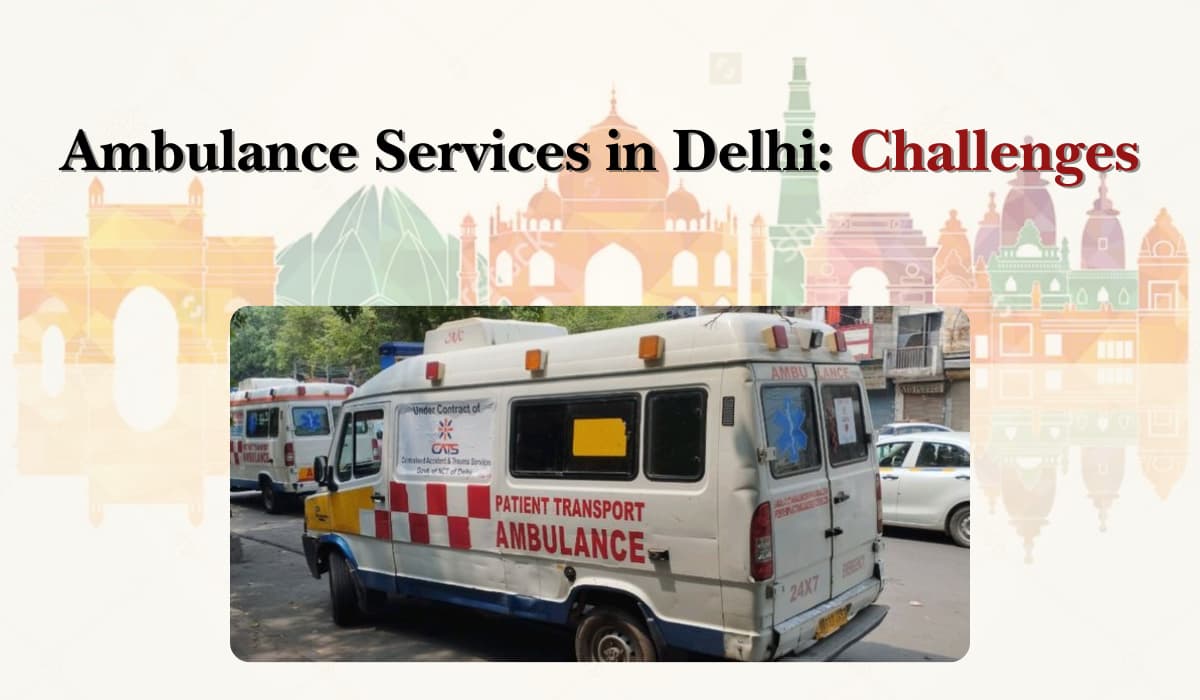

Ambulance services in Delhi are both public and private. The free ambulance services in Delhi are primarily provided by the Delhi government’s Centralized Accident and Trauma Services (CATS). There are also several private companies, which provide ambulance services. However, the development of ambulances as well as the current emergency medical systems in Delhi has many constraints and issues. These problems directly affect the efficiency and quality of care for severely ill and injured patients in the pre-hospital phase. Heaven Gate is here to talk about these issues with Ambulance Services in Delhi.
Inadequate Number of Ambulances
One of the key challenges is the lack of supply of Ambulance Services in Delhi against the number of people in Delhi. As per a report published in January 2021, Delhi had an inadequate number of fewer than 350 CATS ambulances for the estimated 29 million inhabitants of the vast National Capital Territory. This translates to a woefully low ratio of ambulances per thousand population. Some private service providers have contributed towards the expansion of fleet size but the overall figure is still deemed insufficient.
Due to scarcity of ambulances, there are delays in dispatching the nearest ambulance to the emergency spot. It also results in the reliance on rudimentary private cars for emergency transport in many situations. The specific priority areas should be increasing the number of ambulance vehicles.
Infrastructure and Traffic Issues
Some of the problems of Delhi include very congested roads, no lanes for emergency vehicles for easy access and movements of ambulances, potholes and speed breakers. Infrastructure and Traffic challenges affect the response and transport times of ambulances.
The fact is, it often takes a very long time for ambulances to move through traffic and get to the emergency location from the station. More time is wasted in the transport of the patient because of traffic congestion and road networks in the return journey. Prominent improvements include infrastructures and traffic.
Lack of Adequate Paramedics and Emergency Employees
While the problem of the availability of well-equipped Ambulance Services in Delhi has been an issue, a more alarming issue is the shortage of qualified paramedics and emergency personnel in Delhi. Current employees also suffer from problems such as long working hours, no set procedures etc.
These shortages of human resources in pre-hospital emergency care limit the extent to which patients can be provided adequate medical care, monitoring and interventions while in the ambulance en-route to the hospital.
Deficiencies in Organization and Integration to a Single Emergency Number
Another issue is lack of a proper and integrated emergency response network to deal with a variety of disasters. Ambulance services, police and hospitals have very little interconnectivity or synchronization during medical emergencies.
Also, the public struggles to determine which helpline number to dial in case of an emergency to call an ambulance. Delhi does not have a centralized single helpline number for all emergency services like 911 or 999. It is such a system that is required to be built in the present scenario.
Improvement of Remanufacturing Technology and GPS Navigation
A few improvements have been made, but Delhi requires further development of GPS and tracking technologies for operations and dispatches, location systems in ambulances, and real-time traffic data to enhance the number of effective routes and respond quickly. Most of the ambulances have no simple gadgets such as GPS systems which can help in tracking of location, navigation aids, and AVL technology. This technology needs to be improved.
Lack of Access in Outskirts
A significant number of ambulances is found only in and around the Delhi city and there is a severe lack of adequate ambulance services in most rural regions and outskirts of the NCT. This means that there are serious challenges in access to emergency services especially for the population living in the villages and other hard-to-reach areas outside the main city.
Addressing the problem of ambulance availability in the rural areas will call for additional investment in the physical infrastructure and innovative ideas such as having fixed ambulances, partnering with the PHCs etc.
Financial Constraints
Acquiring more ambulances, obtaining latest technologies, hiring more paramedics etc require a good amount of funding and investment which is not possible at the moment due to financial constraints and budgetary issues with the ambulance service providers in Delhi. This challenge can however be overcome in the long-term, by enhancing the government expenditure and funding with private stakeholders.
Conclusion
In conclusion, Ambulance Services in Delhi has many problems such as low density of ambulances per population, traffic problems affecting response times, scarcity of trained paramedics in ambulances, poor coordination between the emergency services, no central helpline number and operational problems due to infrastructural and technological constraints.
The only way to reform Delhi’s ambulance service is through a multi-pronged strategy. Solving these problems will call for dedicated efforts as well as cooperation among different governmental departments, local councils, private healthcare industry, and other parties. Visit Heaven Gate today to know more about our services.
Ambulance Service in Jaipur: Meeting Needs of A Growing City
January 27, 2026[…] and more people experience medical complications that require ambulances. Currently, the government ambulance service in Jaipur are strained and cannot cater to the increasing needs. As per the desired requirements, […]