

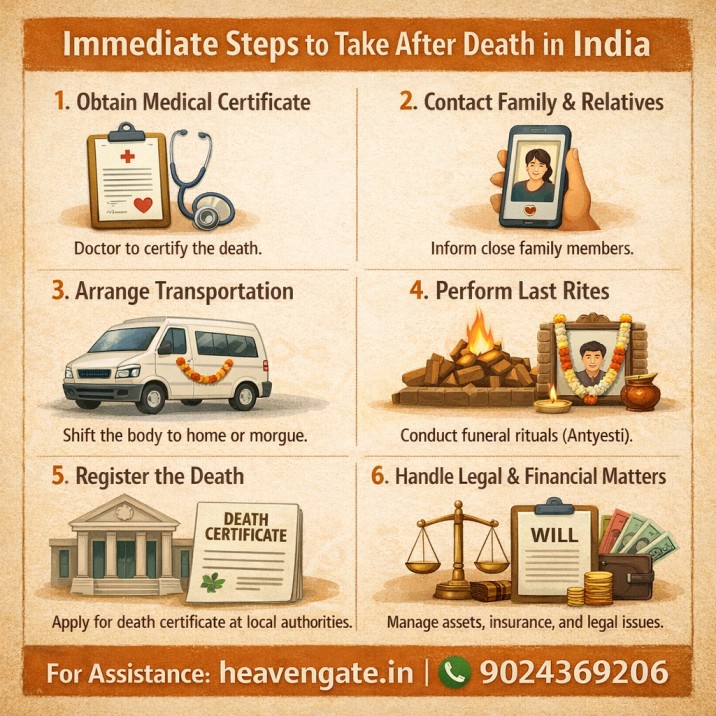

The death of a loved one brings deep emotional pain. At the same time, several legal and practical steps must be handled quickly. Many families feel confused during this period. Therefore, knowing the correct process helps reduce stress and delays.
This guide explains the immediate steps to take after death in India in a simple and structured way.
1. Confirm the Death and Stay Calm
First, the death must be confirmed by a qualified medical professional. If death occurs at home, a doctor should be called immediately. However, in hospitals, confirmation is done by the attending medical staff.
Meanwhile, family members should remain calm. Clear thinking helps in managing the next steps smoothly.
2. Obtain the Medical Certificate of Cause of Death
After confirmation, a Medical Certificate of Cause of Death (MCCD) is required. This document is essential for all future procedures.
In hospitals, the certificate is issued directly
At home, a registered doctor must issue it
In accidental cases, police involvement is mandatory
Without this certificate, further legal processes cannot proceed. Hence, it should be collected without delay.
3. Inform Close Family and Relatives
Once documentation begins, close family members should be informed. Coordination becomes easier when responsibilities are shared.
Additionally, relatives often help with rituals, logistics, and emotional support. Therefore, early communication proves helpful.
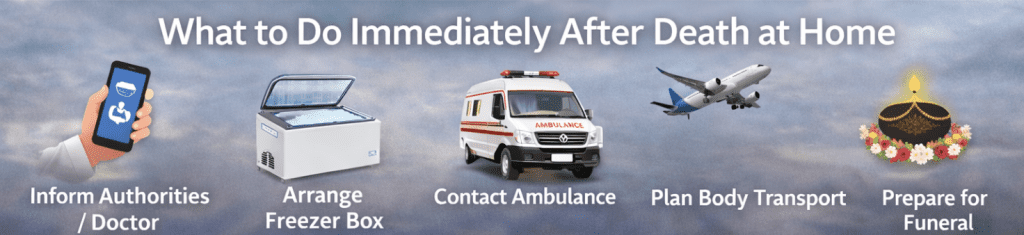
4. Arrange Body Transportation and Preservation
Next, the body may need transportation to a home, mortuary, or cremation ground. In some cases, preservation is required until relatives arrive.
Common arrangements include:
Ambulance or mortuary van
Dead body freezer box
Intercity or interstate transportation
Professional funeral services ensure dignity and hygiene during this step.
5. Decide Funeral Rites and Last Rituals
After logistics are arranged, funeral rites must be planned. Customs vary based on religion and family tradition.
For example:
Hindu families arrange cremation
Muslim families perform burial
Christian families follow church rituals
A priest, pandit, or religious leader may be contacted. Moreover, items required for rituals should be arranged in advance.
6. Register the Death with Local Authorities
Death registration is a legal requirement in India. It must be completed within 21 days.
Required documents usually include:
Medical Certificate of Death
ID proof of the deceased
Address proof
Hospital or police report, if applicable
After registration, an official Death Certificate is issued. This document is critical for all legal matters.
7. Handle Legal and Financial Formalities
After funeral rites, legal processes should begin. Although this step is not immediate, early action prevents future complications.
These tasks include:
Bank account closure or transfer
Insurance claim filing
Pension or employment benefits
Property or succession matters
Therefore, keeping multiple copies of the death certificate is advised.
8. Seek Professional Funeral Support
Managing everything alone can feel overwhelming. Professional funeral service providers assist families during this difficult time.
Their support includes:
Documentation assistance
Transportation services
Cremation or burial arrangements
Prayer meetings and rituals
As a result, families can focus on grieving rather than logistics.
Conclusion
Understanding the immediate steps to take after death in India helps families act with clarity and confidence. While emotions run high, proper guidance ensures that legal, medical, and religious responsibilities are handled respectfully.
If you or your family need compassionate support, trusted funeral professionals can guide you at every step, ensuring dignity and peace during loss.
Frequently Asked Questions (FAQs)
1. What is the first thing to do after a death in India?
The first step is to confirm the death by a registered medical professional. After confirmation, a medical certificate of cause of death must be obtained immediately.
2. Who issues the medical certificate of death in India?
If death occurs in a hospital, the hospital issues the certificate. If death happens at home, a registered doctor must issue it. In accidental cases, police involvement is required.
3. Is death registration mandatory in India?
Yes, death registration is legally mandatory in India. It must be completed within 21 days at the local municipal office or registrar of births and deaths.
4. What documents are required to register a death?
Commonly required documents include the medical certificate of death, ID proof of the deceased, address proof, and hospital or police records if applicable.
5. How many copies of the death certificate should be taken?
It is recommended to obtain multiple certified copies, as they are required for banking, insurance claims, property transfer, and pension-related work.
6. Can funeral rites be performed before death registration?
Yes, funeral rites can be performed before death registration. However, the medical certificate of death must be obtained before cremation or burial.
7. What should be done if death occurs at home?
A doctor should be called to confirm the death and issue a medical certificate. After that, body transportation and funeral arrangements can be made.
8. How soon should funeral services be arranged after death?
Funeral services are usually arranged within 24 hours, depending on religious customs and family preferences.
9. Is professional funeral support necessary?
Professional funeral support is not mandatory, but it helps families manage documentation, transportation, rituals, and legal processes during an emotionally difficult time.
10. What legal work is required after death in India?
Legal tasks include bank account settlement, insurance claims, pension processing, and property succession. These processes require the death certificate.
Deeksha negi
February 14, 2026My husband has been passed away.Call me