

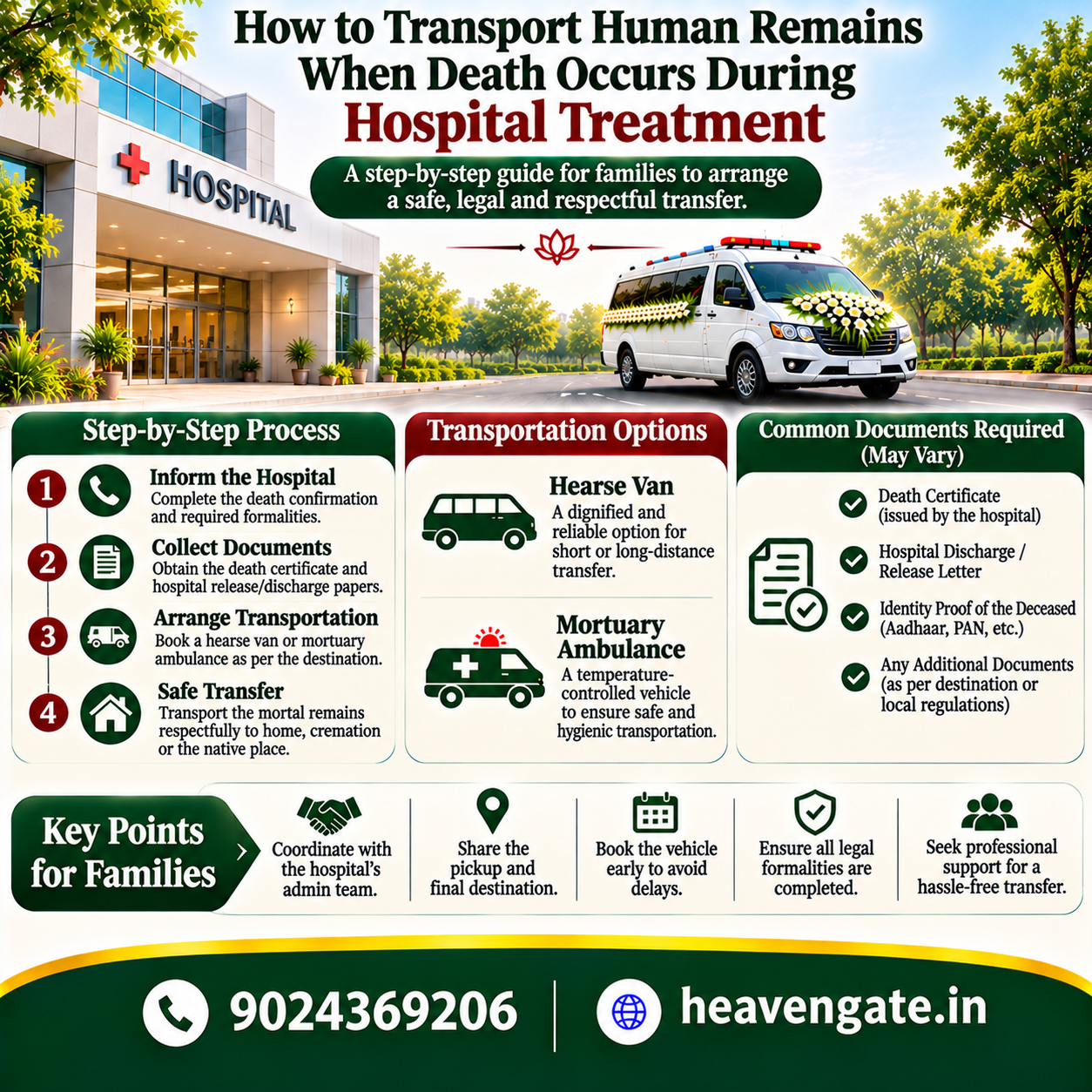

Losing a loved one during hospital treatment is an extremely difficult experience. During this time, families must also manage several important arrangements. These may include hospital formalities, document collection, body release, and transportation to the family home or another destination.
However, understanding the process can help families make informed decisions. A hospital usually follows specific procedures before releasing the deceased. Therefore, families should coordinate with the hospital administration and arrange suitable transportation only after confirming the release requirements.
This guide explains how to transport human remains after a death during hospital treatment. It covers hospital formalities, required documents, mortuary van arrangements, road and air transportation, and final preparations.
1. What Happens When a Patient Dies During Hospital Treatment?
When a patient dies during treatment, the hospital follows its established medical and administrative procedures.
The treating doctor or authorised medical professional confirms the death and completes the applicable documentation. After that, the hospital guides the family through the release process.
Depending on the circumstances, the hospital may also need to coordinate with the police or other authorities.
The family should first speak with the hospital staff and understand the next steps.
Common hospital procedures may include:
Confirmation and documentation of death.
Communication with the family.
Completion of medical records.
Police notification, where applicable.
Post-mortem arrangements, where required.
Completion of hospital clearance formalities.
Release of the deceased to the authorised family representative.
The exact procedure depends on the circumstances of death and applicable rules.
2. First Steps Families Should Take After a Hospital Death
Families may feel overwhelmed by the number of arrangements. However, following a clear sequence can make the process easier.
Step 1: Speak with the Treating Doctor
First, ask the treating doctor or authorised medical professional about the death confirmation and relevant medical documents.
Request clear information about the next formalities. Also, ask whether the case requires any additional medical or legal procedure.
Step 2: Contact the Hospital Administration
Next, speak with the hospital administration or mortuary department.
Ask about the body release process, pending formalities, and the documents required from the family.
Step 3: Confirm Whether Police Involvement Is Required
Some deaths require police involvement or further investigation.
For example, accidental, unnatural, or otherwise legally reportable deaths may require additional procedures.
In such cases, follow the instructions of the hospital and relevant authorities before arranging transportation.
Step 4: Decide the Destination
Discuss where the family wants to take the deceased.
Possible destinations include:
Family residence.
Another hospital or mortuary.
A designated funeral facility.
A cremation ground or burial location, where arrangements permit.
Confirm the destination before booking a vehicle.
Step 5: Contact a Funeral Transportation Provider
Once the family understands the release process, contact a suitable transportation provider.
Share the hospital address, destination, preferred pickup time, and any special requirements.
3. Documents Required to Transport Human Remains from a Hospital
Documentation is an important part of the hospital release and transportation process.
However, the exact requirements depend on the circumstances of death, hospital procedures, and applicable local regulations.
Families may need the following documents:
1. Medical Certificate or Death-Related Medical Records
The treating doctor or authorised medical professional may issue documents related to the death.
Collect the relevant records from the hospital and ask which documents the family must retain.
2. Death Certificate or Applicable Death Documentation
The family may need a death certificate or other accepted death-related documentation.
Ask the hospital or relevant registration authority about the applicable process and timing.
3. Hospital Discharge or Release Documents
The hospital may issue release papers or other documents before handing over the deceased.
Complete the required formalities and keep copies of the relevant paperwork.
4. Identity Proof of the Deceased
Keep an available identity document, such as an Aadhaar card, passport, or another accepted identification document.
5. Identity Proof of the Family Representative
The person collecting the deceased should carry valid identification.
The hospital or transportation provider may request it during verification.
6. Police or Post-Mortem Clearance, Where Applicable
Some cases require police permission, investigation, or post-mortem procedures.
The family must follow the instructions of the relevant authorities before transportation.
7. Embalming or Preservation Documents, Where Applicable
If the circumstances require embalming or another preservation procedure, ask the authorised provider for the relevant certificate or supporting documents.
Important: This is a general guide, not a universal document checklist. Confirm the exact requirements with the hospital, local authorities, and transportation provider before arranging the transfer.
For additional guidance, read Dead Body Transportation Checklist for Families.
4. How to Arrange Dead Body Transportation from a Hospital
After the hospital confirms the release procedure, the family can arrange a suitable transportation vehicle.
The right vehicle depends on the destination, distance, and purpose of the transfer.
Mortuary Van Service
A mortuary van is designed to transport the deceased between hospitals, homes, mortuaries, and other destinations.
Families can enquire about a mortuary van for local or long-distance transportation.
For example, a family may need a mortuary van from a hospital in Jaipur to a residence in Delhi or from a hospital in Ahmedabad to a home in Mumbai.
Hearse Van Service
A hearse van generally supports funeral-related transportation.
Families may arrange it to move the deceased to a home, cremation ground, or another funeral destination, depending on the service.
How to Choose the Right Vehicle
Before booking, consider:
Distance between the hospital and destination.
Type of transportation required.
Vehicle availability.
Pickup and drop-off access.
Preservation requirements.
Additional funeral arrangements.
Also, confirm what the quoted service includes.

5. Road Transportation of Human Remains After a Hospital Death
Road transportation is a common option when families need to move the deceased from a hospital to a home or another city.
A suitable mortuary van can collect the deceased after the hospital completes its release formalities.
However, long-distance transfers require additional planning.
Steps for Road Transportation
Step 1: Confirm the Pickup Location
Share the complete hospital address and pickup instructions with the provider.
Step 2: Confirm the Destination
Provide the full destination address. Also, share the receiving person’s contact details.
Step 3: Discuss Vehicle Availability
Ask whether a suitable mortuary vehicle is available for the required date and time.
Step 4: Confirm Preservation Requirements
Discuss the expected journey and preservation needs with the hospital and provider.
Step 5: Finalise the Booking
Confirm the charges, pickup arrangements, and estimated journey schedule.
Planning a Long-Distance Road Transfer
When the destination is in another city, the family should confirm the route and journey arrangements with the provider.
For example, families may enquire about:
Dead body transportation from Jaipur to Delhi.
Mortuary van service from Ahmedabad to Mumbai.
Dead body transportation from Bengaluru to Pune.
Hearse van service from Hyderabad to another city.
The exact route and journey time may vary with traffic, road conditions, and destination details.
For more information, read Dead Body Transportation by Road: Cost, Documents and Process.
6. Air Cargo Transportation After a Hospital Death
Air cargo may offer another option when families need to transport human remains over longer distances.
However, air transportation involves additional coordination with the airline and authorised cargo handling team.
Families should confirm acceptance before making arrangements.
How Air Cargo Transportation Works
Step 1: Contact the Airline or Cargo Handler
Ask whether the airline accepts human remains on the intended route and date.
Also, confirm the cargo terminal and booking process.
Step 2: Understand Preparation Requirements
The airline or authorised cargo handler may specify packaging, sealing, preservation, and handling requirements.
Obtain these instructions before arranging preparation.
Step 3: Collect the Required Documents
Coordinate with the hospital and relevant authorities to collect the necessary documents.
The airline may also request additional paperwork.
Step 4: Complete the Cargo Booking
Follow the airline’s booking and handover instructions.
Confirm the cargo acceptance deadline. Do not assume that passenger check-in timings also apply to cargo.
Step 5: Arrange Collection at the Destination
Appoint a family representative or authorised person to coordinate cargo collection.
Confirm the cargo terminal, release process, and onward transportation arrangements.
Remember that the passenger arrival terminal and cargo terminal may differ. Also, cargo release may take additional time after the aircraft lands.
Read: Dead Body Transportation by Air in India.
7. Preservation and Preparation Before Transportation
Preservation requirements depend on the condition of the deceased, the expected time before the final rites, and the relevant medical or transportation requirements.
Families may need to discuss these arrangements:
Hospital preparation and release.
Embalming, where required or advised.
A suitable freezer box, where appropriate.
Required packaging and sealing for air cargo.
Proper placement inside the transportation vehicle.
However, families should understand that different preservation methods serve different purposes.
A freezer box does not automatically replace embalming. Similarly, every road transfer does not require embalming.
Therefore, consult the hospital and authorised service provider before selecting a preservation method.
Read: Difference Between Mortuary Freezer Box and Embalming.
8. What If the Death Occurs in an ICU or Emergency Ward?
When death occurs in an ICU or emergency ward, the hospital may need to complete additional procedures before releasing the deceased.
The family should follow the instructions of the treating doctor and hospital administration.
Death During ICU Treatment
The hospital generally completes the required medical documentation and informs the family about the release process.
Ask the hospital about the documents, clearances, and expected handover procedure.
Death in the Emergency Department
The hospital may need to establish the circumstances of death and follow the applicable reporting process.
If the case requires police involvement or further investigation, the family must wait for the relevant clearance.
Death During or After a Medical Procedure
Certain circumstances may require additional review or documentation.
The family should ask the hospital administration which procedures apply before arranging transportation.
In every case, avoid booking a fixed pickup time until the hospital confirms the release arrangements.
9. Arranging the Final Destination and Funeral Services
Once the hospital releases the deceased, the family must coordinate the next arrangements.
The destination may be a family residence, cremation ground, burial location, or another designated facility.
Families should confirm:
Who will receive the deceased.
Whether the destination has suitable vehicle access.
Whether the family needs a mortuary van or hearse van.
Whether preservation arrangements are necessary.
Whether funeral or cremation services need coordination.
If the family plans to conduct the final rites soon after transportation, contact the relevant service providers in advance.
For more information, read Funeral Services in India.
10. Factors That Affect Dead Body Transportation Charges
The cost of transporting human remains after a hospital death depends on the distance and service requirements.
Families should request a clear quotation before confirming the booking.
Common cost factors include:
Distance: The distance between the hospital and final destination can affect transportation charges.
Vehicle type: A mortuary van or hearse van may have different pricing.
Preservation arrangements: Embalming, freezer box arrangements, or other preparation may involve additional charges.
Waiting time: Delays in hospital release or pickup may affect the final quotation, depending on the provider’s terms.
Additional services: Families may request long-distance transportation, onward transfers, or funeral assistance.
For general pricing guidance, read Dead Body Transportation Charges Per KM in India.
11. Common Mistakes Families Should Avoid
A few simple precautions can help families manage the process more smoothly.
Arranging Pickup Before Hospital Release
Do not assume the hospital can release the deceased immediately. Confirm the formalities and expected handover time first.
Ignoring Documentation
Missing documents can delay transportation. Therefore, ask the hospital for a checklist.
Choosing an Unsuitable Vehicle
Understand the difference between a mortuary van and a hearse van before booking.
Overlooking Preservation Requirements
Do not select embalming or freezer box arrangements without understanding the requirements.
Not Planning the Destination
Arrange a receiving person and confirm access before the vehicle departs.
Not Confirming Charges
Ask for a complete quotation. Also, clarify any waiting or additional service charges.
12. How Heaven Gate Funeral Care Can Help
Heaven Gate Funeral Care supports families with funeral transportation and related arrangements.
Families who need dead body transportation after a hospital death can contact the team to discuss their requirements.
Depending on location, circumstances, and service availability, assistance may include:
Dead body transportation from hospitals.
Mortuary van arrangements.
Hearse van services.
Local and long-distance transportation.
Guidance on transportation documentation.
Coordination of preservation requirements.
Funeral and cremation-related assistance.
Families can share the hospital address, destination, and preferred timing to enquire about suitable arrangements.
Internal Link Suggestions
Service Pages
Related Blog Posts
Frequently Asked Questions (FAQs)
1. What should a family do when a patient dies during hospital treatment?
The family should speak with the treating doctor and hospital administration. Confirm the death documentation, release procedure, and any additional formalities before arranging transportation.
2. How can I transport human remains from a hospital to home?
Complete the hospital release formalities first. Then contact a funeral transportation provider, share the destination address, and enquire about a suitable mortuary van.
3. What documents are required after a hospital death?
Documents may include death-related medical records, applicable death documentation, identity proof, and hospital release papers. Police or post-mortem clearance may also apply in certain cases.
4. Can a mortuary van collect the deceased directly from a hospital?
Families can enquire about direct pickup. However, the hospital must complete its release formalities and permit the transfer before the vehicle can collect the deceased.
5. Is embalming compulsory after a hospital death?
Not in every case. The requirement depends on the circumstances, preservation needs, and applicable instructions. Confirm the requirement with the hospital and transportation provider.
6. Is a freezer box required for transporting human remains?
Not necessarily. The need depends on the condition of the deceased and the time before the final rites. A freezer box does not automatically replace embalming.
7. Can human remains be transported from one city to another after a hospital death?
Families can enquire about long-distance transportation through a suitable mortuary van or air cargo. The provider and relevant authorities must confirm the required documents and arrangements.
8. Can families choose air cargo after a hospital death?
Families can enquire with airlines or authorised cargo handlers about human remains acceptance. Air cargo requires additional preparation, documentation, and collection arrangements.
9. How much does dead body transportation from a hospital cost?
The cost depends on the distance, vehicle type, preservation arrangements, waiting time, and additional services. Request a quotation based on the exact pickup and destination.
10. Does Heaven Gate Funeral Care provide hospital-to-home dead body transportation?
You can contact Heaven Gate Funeral Care to enquire about hospital pickups, mortuary van arrangements, hearse van services, long-distance transportation, and related funeral support.